

Last Updated: November 6, 2026
Quick Summary
To improve energy independence, businesses should follow a sequential route: measure energy use with an audit and sub-metering, cut consumption, then generate and store power on site. Reducing demand first shrinks the generation and storage system you need to buy, making energy independence more practical and cost-effective.
- Half-hourly metering shows when energy is used, not just how much, revealing peak demand and overnight baseload.
- Group measures into no-cost actions, medium-cost measures with payback under three years, and capital projects needing feasibility study.
- Size battery storage to cover the evening peak and overnight baseload rather than the whole site.
- The Smart Export Guarantee requires larger electricity suppliers to pay for small-scale renewable electricity exported to the grid.
- A Power Purchase Agreement lets you get commercial solar with no capital investment, with the system installed and maintained for you.
Table of Contents
- 1. Start With a Full Energy Audit and Monitoring
- 2. Cut Consumption Before You Generate
- 3. Commercial Solar Panels for On-Site Generation
- 4. Commercial Battery Storage and Backup Power
- 5. Build a Business Microgrid Around Your Loads
- 6. Business Energy Resilience: Planning for Outages and Peak Demand
- 7. Choose the Right Tariff and Export Your Surplus
- Costs, Payback and Funding for Burnley Sites
- Frequently Asked Questions
1. Start With a Full Energy Audit and Monitoring
Energy independence starts with knowing exactly where every kilowatt-hour goes. You cannot manage what you have never measured, and most sites are measuring far less than they think.
A commercial energy audit is a structured review of how a building consumes electricity, gas and heat, carried out to identify waste, quantify savings and set a baseline for investment. For a manufacturing plant or warehouse in Burnley, that baseline is the foundation for every decision that follows.
What a Commercial Energy Audit Actually Reviews
A proper audit covers more than a walk-round with a clipboard. It examines half-hourly consumption data, equipment load profiles, operating hours, insulation and building fabric, lighting, heating and ventilation performance, and how staff actually use the space. The output is a prioritised list of measures ranked by cost and likely saving, with an indicative payback for each.
Half-Hourly Data and Sub-Metering
Half-hourly metering shows when energy is used, not just how much (How half-hourly settlement will help cut energy bills).
Sub-metering breaks consumption down by building, line or tenant. It turns a single opaque bill into a set of accountable figures, and it usually reveals one or two areas consuming far more than anyone expected.
Watch out: an audit report that ranks measures but does not give you the half-hourly evidence behind each recommendation is hard to defend at board level; ask for the data, not just the conclusions.
Turning the Audit Into a Plan
The most common mistake we see is businesses commissioning an audit and then treating the report as a tick-box exercise. The value sits in the actions, not the document. A workable plan groups measures into three tiers: no-cost and low-cost actions you can start this month (controls settings, switch-off routines, tariff review), medium-cost measures with a payback under three years (LED lighting, insulation, boiler servicing), and capital projects that need a feasibility study (solar, battery storage, microgrid). That sequencing matters because every kilowatt removed by the first two tiers shrinks the generation and storage system you need to buy in the third.
2. Cut Consumption Before You Generate
The cheapest unit of energy is the one you never use. Before committing capital to generation, reduce the load, because every kilowatt removed shrinks the system you need to buy.
Upgrading to LED Lighting and Efficient Equipment
LED lighting is the simplest win on most sites. It cuts lighting energy sharply, lasts far longer than older fittings, and often improves light quality on the floor. Pair it with occupancy sensors in warehouses, corridors and toilets, and lighting stops burning in empty rooms.
The same logic applies to equipment. Motors, compressors, refrigeration and older machinery often run well below modern efficiency standards. Replacing the worst offenders, rather than the whole estate, usually delivers the fastest return.
Insulation, Heating and Boiler Maintenance
Heat loss is quiet money. Poorly insulated roofs, single-glazed units and unsealed loading bays all push the heating system harder than it needs to work. Draught-proofing and loft or roof insulation are unglamorous and effective.
Boiler maintenance is the other half. An annual service, correct water treatment and balanced controls keep a boiler running near its rated efficiency. A neglected boiler quietly loses performance year after year.
Smart Controls and Staff Energy-Saving Behaviour
Smart controls, including thermostats, time clocks and building management systems, stop heating and cooling running when nobody is there. Zonal control matters in large sites where one area is occupied and the rest is not.
Behaviour counts too. Simple habits, such as switching off unused equipment, closing doors and reporting faults, add up across a workforce. Staff training works best when it is specific to the site and repeated, not delivered once as a memo.
3. Commercial Solar Panels for On-Site Generation
On-site generation turns a cost into an asset. Solar panels on a warehouse or factory roof produce electricity where it is consumed, cutting both import volumes and exposure to grid price movements.
For a business with a large, unshaded roof, commercial solar is usually the first generation technology to assess. If you want to see what a commercial installation involves, you can explore commercial solar and battery storage for North West businesses, or if you are based locally, book a solar panel installation survey in Burnley.
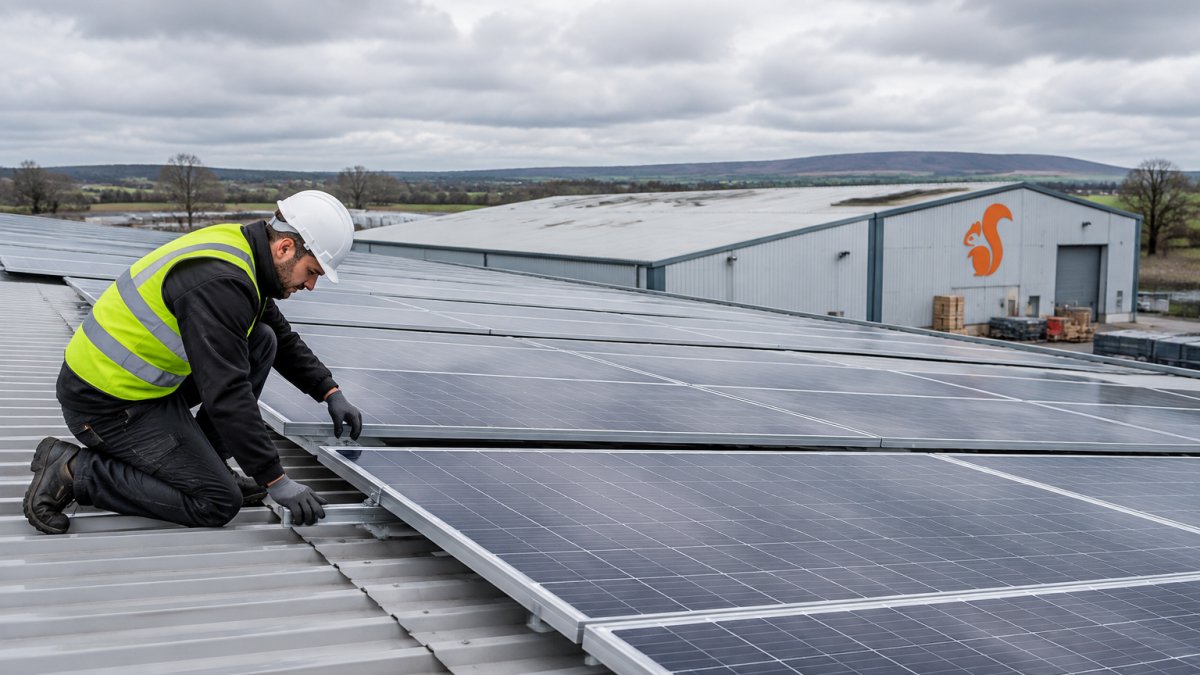
Roof condition, structural loading and shading all need checking before anyone quotes.
4. Commercial Battery Storage and Backup Power
Battery storage is what makes energy independence practical rather than theoretical. Solar generates in daylight; a business runs around the clock. Storage bridges the two.
A commercial battery system stores surplus solar for evening use, shifts grid import away from expensive peak periods, and provides backup power during outages. For farms and food operations, that backup protects livestock systems, refrigeration and grain drying equipment when the grid fails. For a manufacturer running an evening shift, the battery can discharge into the peak and cut the site's maximum demand, which is charged on the highest half-hourly import of the month.
Sizing Storage Around Your Loads
Storage is sized in kilowatt-hours (kWh) of usable capacity and kilowatts (kW) of power. The kWh figure sets how long the battery can run your loads; the kW figure sets how much it can supply at once. A common pattern is to size the battery to cover the evening peak and overnight baseload rather than the whole site, because sizing for every load produces a system that never pays back. Start with your half-hourly data: identify the evening import you want to displace and the critical loads you want to protect, then size to those two numbers.
Safety, Siting and Connection
Battery systems need a suitable location: ventilated, frost-free, away from combustible stock and accessible for maintenance. The installation must comply with the relevant electrical standards, and the connection to your distribution board needs to be designed so the battery can operate safely alongside the grid or in island mode.
Watch out: a battery that is not registered correctly for export can limit your access to Smart Export Guarantee payments; confirm the metering and export arrangements before you sign.
What Storage Delivers Beyond Backup
We install Sunsynk, SolaX and Dyness systems, and we are Smart Export Guarantee registered. If you are weighing the investment, our battery storage installation service across Lancashire explains the systems, and our commercial battery storage ROI analysis for UK businesses sets out payback and revenue streams before you commit.
One honest caveat: battery technology is improving quickly, so specify a system with room to expand rather than buying for today's load alone. A modular system that lets you add capacity later is usually a better bet than a single oversized unit, and it keeps the option open as your loads change.
5. Build a Business Microgrid Around Your Loads
A business microgrid is a local energy system that generates, stores and distributes power across a site, able to run alongside the grid or independently of it. It is the difference between owning some solar panels and owning an energy strategy.
Design starts with your loads, not your kit. Which processes must never lose power? Which can shift to daylight hours? Which are flexible enough to run when generation is high? Answer those and the system sizes itself.
The common mistake is buying generation and storage without mapping loads first. That produces a system that looks impressive on paper and underperforms in practice.
6. Business Energy Resilience: Planning for Outages and Peak Demand
Business energy resilience is the capacity to keep operating through grid outages, price spikes and capacity constraints. It has become a board-level concern for North West manufacturers and cold-store operators alike.
Peak demand is the quieter risk. Sites are charged for the maximum power they draw, so a few simultaneous start-ups can inflate costs for the whole year.
Outages are the louder risk. A short interruption can spoil stock, halt production or damage equipment. Backup power sized to your critical loads keeps the essentials running and gives you time to react.
7. Choose the Right Tariff and Export Your Surplus
The tariff you buy on and the payments you receive for export are two halves of the same decision. Getting one right and ignoring the other leaves money on the table.
Renewable Energy Tariffs and the Smart Export Guarantee
The Smart Export Guarantee is the UK government scheme requiring larger electricity suppliers to pay for small-scale renewable electricity exported to the grid (Smart Export Guarantee (SEG)). Rates vary by supplier, so it is worth comparing before you sign. The official scheme rules are set out by Ofgem's Smart Export Guarantee guidance.
Renewable energy tariffs for business supply are a separate matter. A genuinely renewable tariff should be backed by REGO certificates, and it is worth asking your supplier to evidence that rather than accepting the label.
Costs, Payback and Funding for Burnley Sites
Payback is the question every board asks, and the honest answer depends on your load profile, roof, tariff and how much you self-consume.
Upfront capital is the usual barrier. For businesses that want the benefit without the outlay, a Power Purchase Agreement lets you get commercial solar with no capital investment, with the system installed and maintained for you.
| Measure | Typical Effort | What It Delivers |
|---|---|---|
| Energy audit and sub-metering | Low | Baseline data and waste identified |
| LED lighting and controls | Medium | Immediate consumption cut |
| Insulation and boiler servicing | Medium | Lower heat loss, steadier performance |
| Commercial solar | High | On-site generation, lower imports |
| Battery storage | High | Peak shifting, backup power |
| Tariff and export review | Low | Better rates on import and export |
Burnley businesses face rising grid costs, tighter carbon expectations and a grid that cannot promise uninterrupted supply. The route to energy independence is sequential: measure, reduce, generate, store, and manage the whole system as one.
Frequently Asked Questions
What does energy independence mean for a business?
It means producing and managing enough of your own electricity to cover most or all of your demand, rather than buying every unit from the grid. In practice, that combines efficiency measures, on-site generation such as commercial solar panels, and storage. Squirrel Energy designs systems aimed at 90%+ self-sufficiency for farms and a 4-7 year payback period for commercial installations, so the goal is measurable rather than theoretical.
Can solar panels make a business energy independent?
Solar alone rarely gets a business to full independence because generation stops after dark and drops in winter. Pairing commercial solar panels with commercial battery storage lets you shift daytime generation into the evening and cover peak demand. Add a business microgrid controller and you can decide which loads run on your own power first, which is how most sites move from partial to near-total self-sufficiency.
How does battery storage help businesses use more of their own renewable energy?
Batteries capture surplus generation that would otherwise be exported cheaply, then release it when your site needs it most. That reduces peak demand charges and keeps operations running during a grid outage. Squirrel Energy installs Sunsynk and SolaX approved systems, and because the kit is modular, capacity can be added later rather than replaced wholesale as your needs change.
Are wind turbines suitable for businesses in Burnley?
Suitability depends on your site: open land, mast height, planning permission and noise limits all matter. Wind works best alongside solar because it generates through the winter when solar output falls. Squirrel Energy's free feasibility study assesses whether wind is viable for your location before any capital is committed.
