
Last Updated: November 8, 2026
Quick Summary
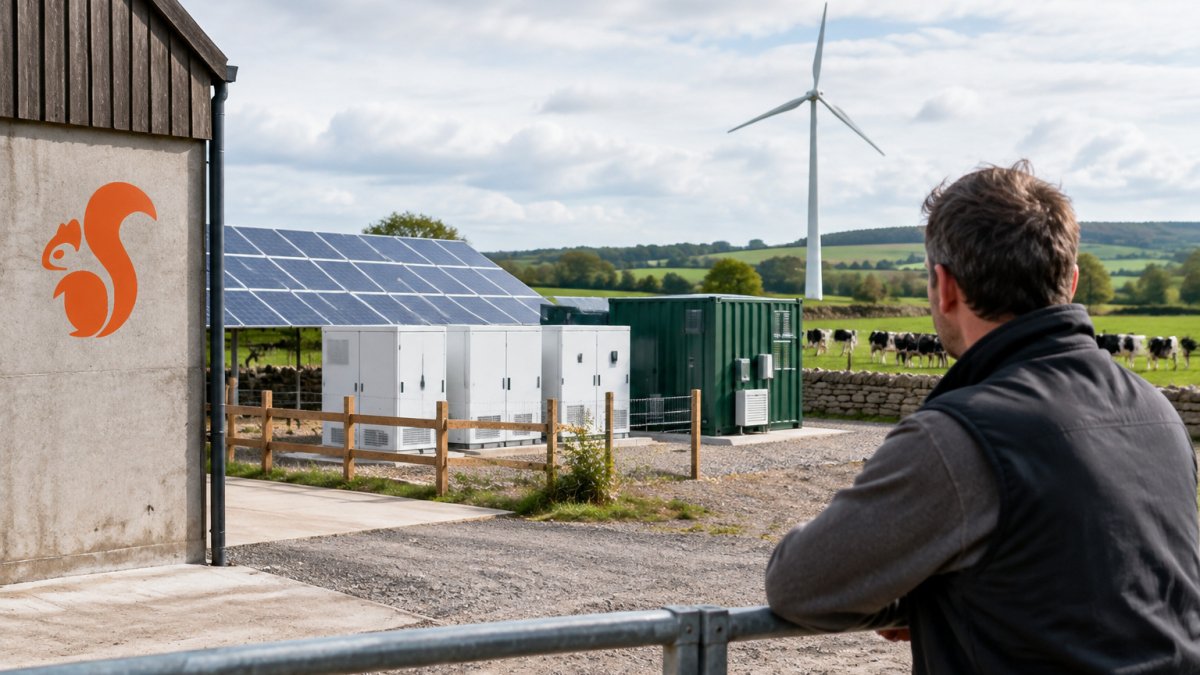
A farm microgrid lowers energy costs, delivers genuine energy independence and keeps power on when the grid goes down. It generates, stores and manages electricity on your own land, coordinating solar, wind and battery storage to run alongside or independently of the central grid.
- Islanding mode detects a grid outage and disconnects automatically, keeping critical circuits live.
- Size the battery to your evening and overnight load, not to the solar array.
- Self-consumed solar saves the full retail import rate, worth more than exporting under the SEG.
- The Annual Investment Allowance, currently £1 million, usually covers the full system cost in year one.
- Separate critical loads at circuit level so the system protects ventilation, milking and water pumps first.
Table of Contents
- What a Farm Microgrid Actually Delivers
- Solar Panels and Battery Storage for Farms: The Core of the System
- How a Farm Microgrid Reduces Farm Energy Costs
- Farm Power Outage Resilience: Keeping Critical Loads Running
- UK Regulations, Planning and Grid Connection
- Limitations, Risks and Maintenance to Plan For
- Why Burnley and Lancashire Farms Are a Good Fit
- Book a Free Energy Audit for Your Farm
- Frequently Asked Questions
What a Farm Microgrid Actually Delivers
A farm microgrid is a localised energy system that generates, stores and manages electricity on your own land, coordinating solar, wind and battery storage to run alongside or independently of the central grid.
The system is not a single product. It is a set of distributed energy resources wired together and controlled by software that decides, moment to moment, whether to use solar power, draw from the battery, or import from the grid.
Grid-connected, stand-alone and islanding modes
A microgrid runs in one of three modes. In grid-connected mode it imports and exports power as needed. In stand-alone mode it operates with no grid connection at all. Islanding mode is the important one for farms: the system detects a grid outage and disconnects automatically, then keeps running on battery and on-site generation.
That islanding capability is what separates a microgrid from a plain solar installation. A standard solar array shuts down during a power cut for safety reasons. A microgrid with the right switchgear and storage keeps the critical circuits live.
Distributed energy resources on a working farm
Distributed energy resources are the individual assets that feed the microgrid. On a farm these typically include:
- Rooftop solar on barns and grain stores
- Ground-mount arrays on less productive land
- Small wind turbines where the site is exposed
- Battery storage for shifting and backup
- Backup generation, often an existing diesel set
- Load management controls for high-draw equipment
The controller ties these together. What most guides miss is that the value sits in the control layer, not the panels. Two farms with identical hardware can see very different returns depending on how the system prioritises loads.
A microgrid runs in one of three modes, and the differences matter for a working farm.
| Mode | How it operates | Key point for farms |
|---|---|---|
| Grid-connected | Imports and exports power as needed | Normal operation alongside the central grid |
| Stand-alone | Operates with no grid connection at all | Full independence from the grid |
| Islanding | Detects an outage and disconnects automatically | Keeps critical circuits live on battery and on-site generation |
Solar Panels and Battery Storage for Farms: The Core of the System
Solar panels and battery storage together cover both generation and timing. Solar produces during daylight, often when farm demand is moderate; the battery stores the surplus and releases it when irrigation, cooling, grain drying or milking equipment drives demand up.
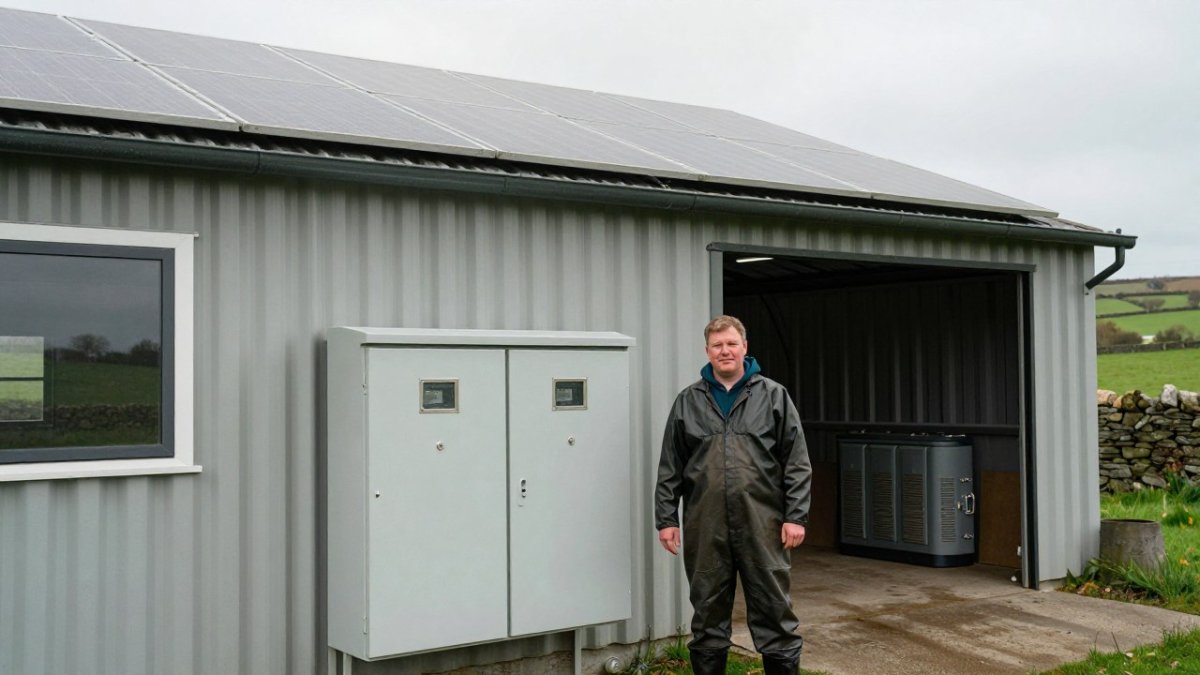
For the full picture of what we install, see our renewable energy for farms and rural businesses service, which covers barn roof solar, ground-mount arrays, wind turbines and battery storage.
Sizing generation and storage to your load profile
Sizing starts with your load profile, not your roof area.
A common mistake is sizing the battery to the solar array rather than to the evening and overnight load. The array should match daytime generation; the battery should match what you need to carry through to the next morning. Getting that relationship wrong is the fastest route to a system that looks impressive on paper and underperforms in practice.
How a Farm Microgrid Reduces Farm Energy Costs
The cost case rests on four levers: self-consumption, price volatility, export income and capital allowances. Every unit of solar you use on site replaces an imported unit at the full retail rate, which is worth more than exporting it. A battery raises self-consumption by moving generation to the hours you actually need it.
Load and demand management controls can defer non-critical draws automatically, grain drying, slurry pumping and cold-store pull-down are the usual candidates.
The third lever is the Smart Export Guarantee, the UK scheme obliging larger suppliers to pay for exported electricity (Smart Export Guarantee (SEG)). Rates vary by supplier and tariff, so check current rates before you model returns.
The fourth lever is tax.
A worked example for a Lancashire dairy unit
Take a 200-cow dairy near Burnley with a half-hourly load profile of roughly 180,000 kWh a year, a winter peak driven by ventilation and bulk-tank refrigeration, and a south-facing barn roof of about 250 m².
At a commercial import rate of around 25p per kWh, every unit of solar self-consumed saves 25p; every unit exported under the SEG earns perhaps 5-15p depending on the supplier.
On payback, we are deliberately cautious. If you want to build your own model first, our guide on how to calculate solar power return on investment walks through payback, capital allowances and battery storage in seven steps.
Stress-testing the numbers before you commit
A single payback figure is not a business case. Run at least three scenarios: base case at today's import price, a low case with import prices 20-30% lower, and a high case with a battery replacement in year 12-15.
Watch out: a payback model built on today's high import prices alone will flatter the case. Stress-test it against lower future prices and a falling SEG rate before you commit capital, and treat any installer who quotes a single guaranteed payback without showing assumptions with suspicion.
Farm Power Outage Resilience: Keeping Critical Loads Running
Resilience is where a microgrid earns its place on a farm that has never had a power cut it couldn't ride out. Once those essential circuits are defined, weighing solar generation against backup power options helps shape a system that keeps the farm running when the grid fails.
On most livestock and arable sites, critical loads include:
- Ventilation and cooling in livestock buildings
- Milking and bulk tank refrigeration
- Grain drying and storage controls
- Water pumps and borehole supply
- Security, alarms and site lighting
Everything else can wait. This is why we ask for a circuit-level survey rather than a single total consumption figure. A microgrid sized to carry the whole farm through an outage is far larger and costlier than one sized to carry the loads that matter.
Islanding gives you energy security without a generator running through the night. Where a diesel set already exists, the microgrid can manage it as backup rather than replacing it, which usually improves the economics.
UK Regulations, Planning and Grid Connection
Most farm solar installations fall within permitted development rights, but the rules are specific and have changed in recent years. The relevant framework is the Town and Country Planning (General Permitted Development) (England) Order 2015, as amended, and the position differs in Scotland, Wales and Northern Ireland.
Battery storage is a separate planning question from solar. Larger standalone batteries may need consent in their own right, and fire-safety guidance for lithium-ion installations is still evolving. Build that into the design stage rather than discovering it at commissioning.
Grid connection and the distribution network operator
Any system that exports, or that needs a larger import capacity, requires an application to your distribution network operator, in Lancashire that is typically Electricity North West. The process runs through the national connection queue and can take months, and the answer may come with conditions, a reinforcement cost or an export limitation.
Smaller systems may qualify for a simplified notification route rather than a full application, but the thresholds and forms change, so confirm the current process with your DNO before assuming a fast connection.
Standards, certification and who enforces them
Installation standards matter too. MCS certification is the recognised UK quality benchmark for small-scale renewables, and it underpins access to export schemes and most grant funding.
If you are claiming grant funding, check the scheme rules before you start, some require prior approval or specified installer accreditation, and retrospective claims are usually rejected.
Watch out: permitted development rights can be withdrawn in some areas and the export threshold rules change periodically.
Limitations, Risks and Maintenance to Plan For
A microgrid is not maintenance-free, and any installer who tells you otherwise is overselling. Solar arrays need periodic cleaning and inverter checks. Batteries lose capacity gradually over their service life. Controllers need firmware updates and occasional reconfiguration as your load profile changes.
There are genuine risks to weigh:
- Battery technology moves quickly. Buy on warranty terms and round-trip efficiency, not on the promise of future upgrades.
- Export rates can fall. Don't let SEG income carry the whole business case.
- Load profiles drift. Adding a grain dryer or expanding a herd changes the maths; the system needs re-tuning.
- Fault support matters. Ask who you call at 2am and whether they will still be trading in five years.
The honest limitation is scale. A microgrid that makes sense on a large dairy unit may be harder to justify on a smallholding with modest consumption. We would rather tell you that at the audit stage than sell you a system that never pays back.
Why Burnley and Lancashire Farms Are a Good Fit
Lancashire's farm buildings are well suited to this. Large barn and shed roofs offer generous south-facing area, and many sites have unused land that can take a ground-mount array without touching productive acreage.
The local grid picture matters too. Rural connections in parts of Lancashire can be constrained, and farms at the end of a long overhead line are more exposed to outages. If you want to check coverage and arrange a visit, our solar panel installation in Burnley page sets out what we offer locally.
Book a Free Energy Audit for Your Farm
The right first step is measurement, not a quote. For the hardware side, our farm micro grid systems built for self-sufficiency page explains island mode and what 90%+ self-sufficiency looks like in practice, and our battery storage installation page covers the storage options we fit across Lancashire and the North West.
The challenge is straightforward: energy costs and outage risk are both rising for farms, and the grid alone will not solve either. Squirrel Energy designs bespoke solar, battery and microgrid systems, with MCS certified installation and Smart Export Guarantee registration.
Frequently Asked Questions
What are the main benefits of a microgrid for a farm?
A farm microgrid combines on-site generation, battery storage and control equipment to cut electricity bills, protect against price volatility and keep critical loads running during outages. It also supports decarbonisation by using renewable energy instead of imported grid power. Most farms also gain better visibility of where power is used, which makes load management and demand management easier.
Can a farm microgrid keep essential equipment running during a power cut?
Yes, provided the system is designed for islanding and the critical loads are separated onto a dedicated circuit. Milking parlours, livestock ventilation, grain drying fans, feed systems and cold storage are the usual priorities. Farm power outage resilience depends on battery capacity, the load you choose to back up and how quickly the system disconnects from the central grid. A feasibility study should map your critical loads first, then size storage to cover the outage length you want to ride through.
How much does it cost to install a microgrid on a UK farm, and what is the payback?
Costs vary widely with generation size, battery capacity, switchgear and any grid connection upgrades, so pricing depends on your site and load profile rather than a single figure. On payback, commercial systems typically target a 4 to 7 year period, and farms often reach 90% or more self-sufficiency. Your actual figure depends on current electricity bills, export income through the Smart Export Guarantee and how much generation you can use on site.
Can a farm microgrid operate independently from the National Grid?
It can run as a stand-alone system, but most farms keep a grid connection for backup and export. A grid-connected system with islanding capability gives you the best of both: import when generation is low, export surplus through the Smart Export Guarantee, and disconnect to run on your own power during an outage. Full independence needs enough battery storage and generation to cover winter demand, which usually raises capital cost. Discuss the trade-off during your feasibility study before committing.
