
Last Updated: November 12, 2026
Quick Summary
To hire renewable energy consultants in the UK, check for MCS certification and Smart Export Guarantee registration, confirm who designs the system, and insist on a site survey before any quote. A good consultant also provides a feasibility study with stated assumptions, written handover deliverables and clear aftercare arrangements.
- Confirm MCS certification and Smart Export Guarantee registration before comparing any providers.
- Ask who designs the system and whether an electrical engineer signs off the design.
- Insist on a site survey before accepting any recommendation or figure.
- A feasibility study should show its energy price, export rate and self-consumption assumptions.
- Ask what you receive at handover and who you call if the system develops a fault.
Table of Contents
- What a Renewable Energy Consultant Actually Does
- Consultant, Installer or Recruiter: Knowing the Difference
- Renewable Energy Feasibility Study: What to Expect
- How to Choose a Renewable Energy Installer
- Renewable Energy Consultants for Farms
- Renewable Energy Project Timeline: From Survey to Handover
- Questions to Ask Before You Book a Renewable Energy Consultant
- Booking a Free Energy Audit with Squirrel Energy
- Frequently Asked Questions
What a Renewable Energy Consultant Actually Does
Renewable energy consultants work out whether a solar, battery or wind project makes sense for a particular site, and then guide it through to completion. Their job starts well before any panels go on a roof and continues long after handover.
At Squirrel Energy, our systems are custom designed by electrical engineers with over 40 years of experience, so each design reflects the actual site, the actual energy demand and the actual goals of the client.
A good consultant typically covers:
- Site assessment: roof structure, orientation, shading, ground conditions and grid connection.
- Energy analysis: how much electricity is used, when, and where savings are possible.
- System design: sizing of solar arrays, batteries, inverters and any backup generation.
- Compliance: making sure the work meets the standards the installation must satisfy.
- Aftercare: monitoring performance and supporting the client once the system is running.
Watch out: a consultant who skips the energy analysis and goes straight to a design is selling hardware, not a solution.
Consultant, Installer or Recruiter: Knowing the Difference
These three roles sound similar, but they do very different jobs. Confusing them is one of the most common reasons projects go wrong.
A consultant advises on what to build and why, and oversees the technical decisions. An installer physically builds and commissions the system. A recruiter finds people to fill roles, such as engineers or project managers, and does not design or install anything.
Many firms blur these lines, so ask direct questions. Who designs the system? Who signs off the electrical work? Who will you call in five years if something fails?
Renewable Energy Feasibility Study: What to Expect
A feasibility study tests whether a project is technically and financially viable before money is committed.
A properly scoped study is not a sales document. It should be structured so that each conclusion can be traced back to an assumption you can challenge. A credible study typically covers the following stages.
1. Site and constraint review. A site visit to record roof structure and covering, orientation, shading from trees or neighbouring buildings, ground conditions for any ground-mounted array, and the location and capacity of the existing electrical supply.
2. Energy demand analysis. A review of half-hourly or monthly consumption data, ideally at least twelve months, to establish baseload, peak demand and seasonal variation.
3. Preliminary design and yield estimate. An indicative array size, inverter and battery specification, and an estimated annual generation figure. Good studies state the assumptions behind the yield estimate, including shading losses, soiling and degradation, rather than presenting a single headline number.
4. Grid and connection assessment. Whether the existing connection can accept export, whether a Smart Export Guarantee route is available, and whether the site needs a larger supply, an export limitation scheme or a grid-independent design.
5. Financial modelling. A payback estimate and a simple cash-flow view built on stated energy prices, assumed export rates and the expected self-consumption ratio.
6. Planning and consenting screening. Whether the proposal needs planning permission, whether it falls under permitted development, and whether any ecological, heritage or landscape assessment is triggered. For ground-mounted arrays and battery compounds this screening should happen before design is fixed.
7. Risk register and recommendations. A short list of the principal technical, commercial and regulatory risks, with a clear recommendation on scope, phasing and next steps.
We offer free energy audits and feasibility studies as the first step, so clients can see the numbers before deciding anything.
Watch out: a study that presents a payback figure without showing its energy price, export rate and self-consumption assumptions is not a feasibility study, it is a sales projection.
The seven stages of a feasibility study, and what each one establishes before money is committed:
| Stage | What it establishes | Key question |
|---|---|---|
| Site and constraint review | Roof, orientation, shading, ground and supply | Can the site physically take a system? |
| Energy demand analysis | Baseload, peak demand and seasonal variation | What does the site actually use, and when? |
| Preliminary design and yield estimate | Indicative array, inverter and battery sizing | How much will it generate? |
| Grid and connection assessment | Export capacity and connection options | Can the existing connection cope? |
| Financial modelling | Payback and cash flow on stated assumptions | What are the energy price and self-consumption assumptions? |
| Planning and consenting screening | Permission and assessment requirements | Does the project need permission? |
| Risk register and recommendations | Principal technical, commercial and regulatory risks | What should happen next, and in what phases? |
How to Choose a Renewable Energy Installer
Choosing an installer is a bigger decision than most buyers expect, because the system will run for decades and the design decisions made at the start are hard to reverse later.
Credentials and compliance. Look for MCS certification. Check whether they are registered for the Smart Export Guarantee. Ask which inverters and batteries they are approved to fit. For commercial and agricultural sites, ask whether they have experience of the Distribution Network Operator connection process.
Who actually designs the system. This is the single most predictive question. Ask who carries out the design, what their engineering qualifications are, and whether the design is signed off by an electrical engineer or assembled by a salesperson from a catalogue.
Site survey before any figure. Be wary of anyone who quotes a fixed price without a site survey. Every system should be designed around the specific building, its load profile and its constraints. A provider who will not visit before quoting is selling hardware, not a solution.
Deliverables in writing. Ask what you will receive at handover: a design drawing, a yield estimate with assumptions, a schematic, commissioning certificates, and a monitoring setup. A provider who cannot describe these deliverables before you commit is unlikely to produce them afterwards.
Aftercare and fault response. Ask who you call in five years if something fails, what the response arrangement is, and whether monitoring is included.
References from comparable sites. Ask for examples from businesses or farms similar to yours, and ask what the measured performance has been rather than what was predicted. A provider with genuine commercial and agricultural experience will have these to hand.
A practical comparison framework. Score each provider you shortlist against the same six headings: credentials, design accountability, survey-before-quote, written deliverables, aftercare, and comparable references. A provider that scores well on credentials but poorly on design accountability is a risk, because the design is what determines whether the system performs.
At Squirrel Energy, our systems are custom designed by electrical engineers with over 40 years of experience. Clients work with a single accountable designer, and we encourage prospective clients to compare providers on design accountability rather than on headline equipment alone.
Renewable Energy Consultants for Farms
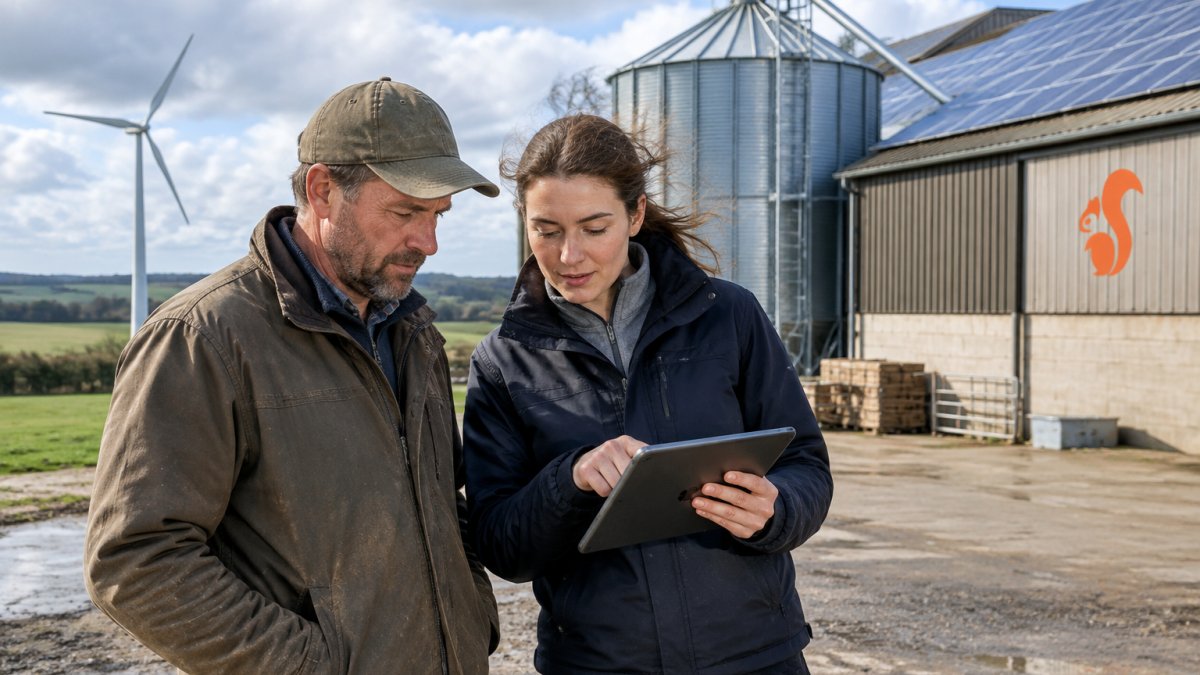
Farms have specific needs that differ from homes and offices. Many farm owners want to understand their options and carry out some of the work themselves, which makes a specialist partner especially valuable.
Farm energy demand is often high and irregular, with grain drying, livestock systems and machinery all drawing power at different times. Check whether Squirrel Energy covers your area before you plan further. A consultant can size a system to match those peaks, and design a grid-independent micro-grid where the grid connection is weak or expensive.
Our farm systems combine solar, battery storage and, where suitable, wind, with backup generation. Read about a complete farm micro grid system built for self-sufficiency and resilience. You can explore the full range of farm renewable energy installs we offer, from barn roof solar to complete micro grids.
Renewable Energy Project Timeline: From Survey to Handover
A well-run project moves through clear stages. Knowing them in advance helps you plan around the disruption.
- Survey: a site visit to assess roof, ground, electrical supply and energy use.
- Design: engineering work to size the system and confirm it meets the site's needs.
- Approvals and paperwork: grid connection applications and any required notifications.
- Installation: physical fitting of panels, batteries, inverters and wiring.
- Commissioning: testing, switching on and handing over the system.
- Handover and aftercare: training, documentation and ongoing monitoring.
Timelines vary with the size of the project and the speed of grid approvals. Ask any provider to give you a realistic schedule rather than a best-case promise, and to explain how they will keep you informed.
Questions to Ask Before You Book a Renewable Energy Consultant
The right questions reveal far more than a sales presentation. For expert advice on choosing solar and battery storage, including system sizing and returns, read our guide first. Use these before you commit.
- Who will design my system, and what are their qualifications?
- Are you MCS certified, and are you registered for the Smart Export Guarantee?
- Will you carry out a site survey before giving me any recommendation?
- Which inverters and batteries do you install, and why?
- What happens if the system develops a fault, and who do I call?
- Can you show me examples from businesses or farms similar to mine?
- What is your realistic timeline from survey to handover?
We do not quote prices, because every system is custom designed for its site. Instead, we explain the reasoning behind each recommendation so you can judge the value for yourself.
Booking a Free Energy Audit with Squirrel Energy
If you are weighing up a solar, battery or micro-grid project, the simplest next step is a conversation with our engineers. Our free energy audit looks at your current usage, your site and your goals, and gives you an honest view of what is practical.
Squirrel Energy designs and installs bespoke solar, battery and wind systems, with a focus on energy independence and resilience against grid outages. Our team holds MCS certification and works with Sunsynk and SolaX equipment. Get in touch to book your audit.
Frequently Asked Questions
What does a renewable energy consultant do?
A renewable energy consultant assesses a site, works out which technologies suit it, and manages the project from feasibility to delivery. Typical work includes energy audits, feasibility studies, engineering design, planning and consenting support, and advice on solar, battery storage and wind. A good consultant is independent of any single equipment supplier, so the recommendation reflects your load profile and goals rather than a product they want to sell. Ask whether they provide technical design as well as advice, as that affects who is accountable if the system underperforms.
How do I choose a renewable energy consultant in the UK?
Start by checking that they have verifiable experience with projects similar to yours, whether that is a farm, a manufacturing site or a warehouse. Look for qualified electrical engineers on the team, clear scope in writing, and an explanation of how they charge. Ask for references or case studies you can verify. Compare at least three proposals on the same basis, so you can see differences in design depth and after-sales support rather than just the headline figure.
Do farms need a specialist renewable energy installer?
Farms usually benefit from a specialist because grain drying, livestock systems and remote sites create load patterns that general domestic installers rarely design for. A specialist will size storage and generation around peak demand and can address grid-independent micro-grid options where a grid connection is weak or expensive. Many farm owners do some of the work themselves, and a specialist can define which tasks you handle and which need certified engineering, so the project stays compliant and performs as designed.
How long does a commercial renewable energy project take?
The timeline depends on site complexity, grid connection requirements and planning needs, so there is no fixed figure that applies to every project. In general, the stages run from site survey and feasibility study through to engineering design, procurement, installation, commissioning and handover. Ask any consultant or installer to set out the stages and expected duration in writing, and to explain which steps could extend the timeline, such as grid approval or roof structural checks.
