
Table of Contents
- Why Manufacturing Plants Are Turning to Commercial Solar
- The Best Solar Panel Manufacturers for Industrial Sites
- Grid-Tied, Off-Grid and Hybrid Systems for Factories
- How to Integrate Solar Panels with Existing Diesel Generators
- Commercial Solar Battery Storage in the UK: What Manufacturers Need to Know
- Industrial Solar Panel ROI Calculation with a Worked Example
- Booking a Free Feasibility Study for Your Burnley Site
- Frequently Asked Questions
Last Updated: November 4, 2026
Why Manufacturing Plants Are Turning to Commercial Solar
Choosing the best solar for manufacturing plants comes down to one question: how much of your daily load can you power from your own roof? For many Burnley factories, the answer is more than most managers expect. Squirrel Energy designs commercial solar systems that cut grid electricity bills, and the right specification matters for a busy production site.
Energy is now one of the largest overheads on a factory's balance sheet, and it rarely falls on its own. Operations managers across Lancashire, Yorkshire, Cumbria and Greater Manchester are looking for ways to bring that cost under control without disrupting production. Solar is one of the few options that generates value every daylight hour.
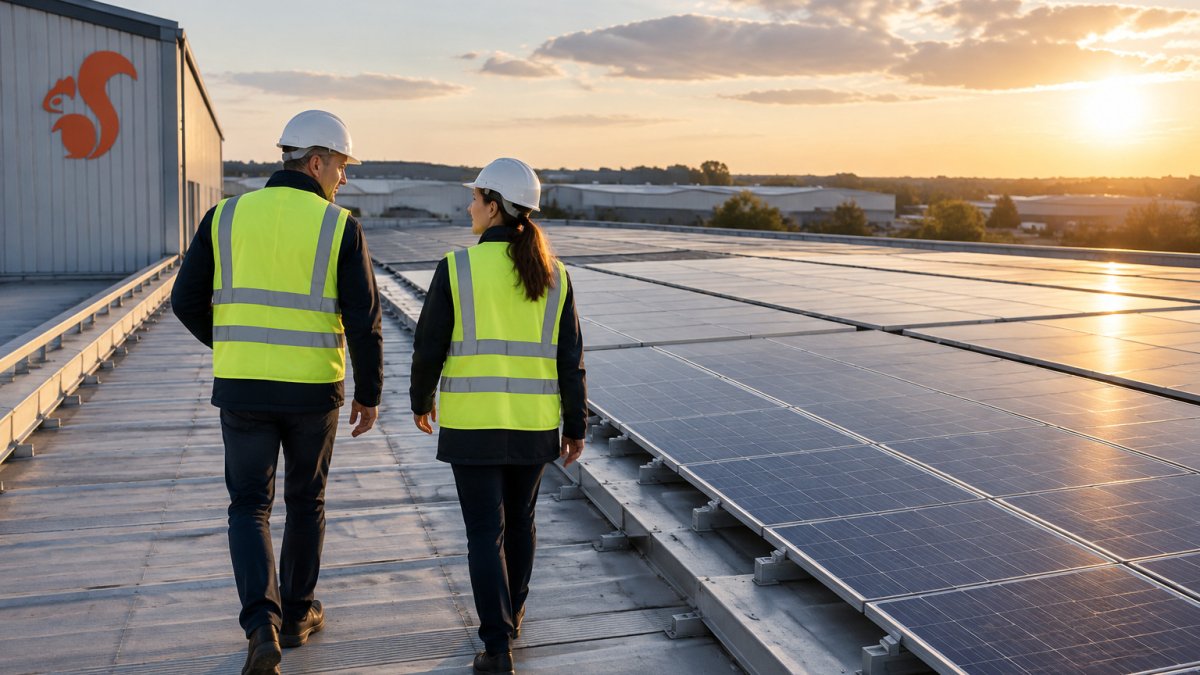
A factory is a different proposition from an office. Production runs during the day, machinery draws heavy loads and the roof is often large and flat. Those features suit commercial solar well, but they also raise questions about structure, load matching and how the system will fit around existing equipment. Getting those answers right at the start is what separates a good investment from a disappointing one.
Our advice is to treat solar as an operational decision, not just a purchase. Start by reviewing twelve months of half-hourly consumption data, then assess the roof. The rest of this guide covers the options we would weigh for a manufacturing site, from panel choice to battery storage and return on investment.
The Best Solar Panel Manufacturers for Industrial Sites
Panel brand matters less than many buyers assume, but it still affects warranty cover, long-term output and how easily a fault gets resolved on a live production site. For industrial sites, the useful questions are narrower than the consumer market: is the manufacturer a recognised Tier 1 supplier, what do the product and performance warranties actually promise, and can the installer support that brand locally when something fails in year eight?
A practical shortlist for a manufacturing plant usually comes down to a handful of brands that are widely stocked and serviced in the UK. The right choice is the one your installer can source, fit to MCS standards and support through its warranty period, not simply the highest-efficiency panel on a datasheet.
Three factors should drive the shortlist. Look at conversion efficiency, which determines how much power each square metre of roof can produce, most mainstream commercial monocrystalline panels now sit in the 20-23% range, with premium models a little higher. Check the product and performance warranties: a typical product warranty runs 12-15 years, while a performance warranty guarantees roughly 80-87% of rated output at year 25. Finally, confirm that the installer is certified to fit the chosen panels to MCS standards, because that certification underpins your eligibility for export payments and is often requested by insurers.
Squirrel Energy works with approved equipment, including inverters from Sunsynk and SolaX. Pricing depends on system size, roof condition and the kit specified, so we recommend requesting a site-specific quote rather than relying on generic figures.
Panel Efficiency, Output and Warranty Compared
Efficiency is the headline number, but it is only one part of the picture. A panel with slightly lower efficiency can still make sense if it is cheaper per watt or carries a stronger warranty. Output also depends on orientation, shading and temperature, so the nameplate rating rarely tells the whole story, a flat roof in Burnley will run cooler than a south-facing pitched roof in summer, and cooler panels produce more.
| Factor | Why it matters for a factory | What to check |
|---|---|---|
| Conversion efficiency | Determines output per square metre | Compare on the same roof area, not on headline wattage |
| Product warranty | Covers panel defects over many years | Length, what is covered, and who honours it in the UK |
| Performance warranty | Guarantees output after decades | Minimum retained output at year 25 (typically 80-87%) |
| Temperature coefficient | Affects output on hot roof surfaces | A lower loss per °C suits large flat roofs |
| Installer certification | Protects your MCS eligibility | Confirm MCS status and insurance-backed workmanship cover before signing |
Watch out: a warranty is only as good as the entity backing it. Check whether the manufacturer has a UK or EU service presence, and ask your installer what happens if the brand exits the market mid-life.
For a manufacturing plant, the panel is the least differentiated part of the system. The inverter, mounting structure, isolators and monitoring are where specification mistakes tend to surface, so treat the panel shortlist as a starting point rather than the whole decision.
Grid-Tied, Off-Grid and Hybrid Systems for Factories
Most manufacturing plants will choose a grid-tied system, because it keeps the factory connected to the national grid while cutting daytime imports. Grid-tied arrays are simpler to install and usually offer the fastest route to savings. They do not provide backup power during an outage unless paired with storage.
An off-grid system is rarely practical for a factory. Industrial loads are large and continuous, and matching them with solar alone would require a very large array and substantial storage.
Hybrid systems sit between the two. They combine solar, battery storage and grid connection, allowing a site to use its own generation, store surplus and draw from the grid when needed. For plants that run shifts or face unreliable supply, this is often the most resilient option.
How to Integrate Solar Panels with Existing Diesel Generators
Many factories already own diesel generators for standby power. Integrating solar with that equipment is possible, but it needs careful design. The main challenge is control: the generator must not start unnecessarily, and the solar inverter must not fight the generator for control of the supply.
The practical approach is to use a controller that manages the generator, solar output and any battery together. Set the generator as the backup source, so it runs only when solar and storage cannot meet demand. Test the changeover carefully before the system goes live, and confirm that the generator's maintenance schedule still suits its reduced running hours.
A common mistake is assuming existing generator controls will work unchanged with new solar equipment. They often need reconfiguring. Involve your installer and generator service provider early, and do not leave the integration until the end of the project.
Commercial Solar Battery Storage in the UK: What Manufacturers Need to Know
Battery storage lets a factory use more of the solar power it generates. Without storage, surplus output during quiet periods is exported or lost, so the savings from a daytime array are capped by the factory's daytime demand. Storage moves that surplus into the evening or to the next shift.
Before committing, weigh up the usable capacity, expected cycle life and the cost of the battery against the value of the energy it shifts. Battery technology is developing quickly, so ask how the system can be expanded later, rather than assuming a fixed setup will remain current for its whole life.
Storage also supports resilience. A battery can keep critical loads running during short grid interruptions, which matters for plants where a power cut means lost product or damaged equipment. Squirrel Energy can help assess how storage might change your self-consumption and payback before you invest.
Industrial Solar Panel ROI Calculation with a Worked Example
Return on investment is the question every board asks, and it deserves a clear method rather than a headline payback figure. Work it out in five steps: establish the annual electricity cost and the tariff you actually pay, estimate the annual solar generation the roof can deliver, calculate the share your factory will use itself, value the exported units, and then divide the net upfront cost by the annual saving.
Here is a worked example for a hypothetical Lancashire plant. Suppose the site uses 400,000 kWh a year and pays a commercial unit rate of around 22p per kWh, giving a grid electricity bill of roughly £88,000 before standing charges. A 150 kWp rooftop array on a large flat roof might generate around 130,000 kWh a year in this region.
Against a capital cost of roughly £90,000-£120,000 for a 150 kWp commercial system installed on an existing roof, that gives a simple payback of about four to five years and a 20-year saving in the region of £400,000-£500,000 before maintenance and inverter replacement. Those figures are illustrative, not a quote: the actual numbers depend on your tariff, your load profile, roof condition and the kit specified.
The sensitivity matters more than the central case. If your unit rate rises to 30p, the same system pays back closer to three and a half years; if it falls to 15p, payback stretches towards six. If self-consumption drops from 80% to 50% because your heaviest loads run at night, the saving falls sharply and the case for a battery improves.
A few UK-specific assumptions are worth stating explicitly. Business rates treatment of rooftop solar depends on the system size and how it is rated, so confirm the position with your rating adviser before signing. Export payments are typically made under a Smart Export Guarantee tariff from a licensed supplier, and the rate varies, so compare options before accepting a default (Smart Export Guarantee (SEG)).
Squirrel Energy's stated payback period for commercial systems is 4 to 7 years, but that depends on the factory's load profile and the system design, so treat it as an indication rather than a guarantee. Ask for a modelled projection based on your actual data, and ask for the downside case as well as the central one.
Watch out: a payback calculation built on an assumed self-consumption figure rather than your metered data can lead to a disappointing business case.
Booking a Free Feasibility Study for Your Burnley Site
The most reliable way to find out what solar can do for your plant is a site survey. Squirrel Energy offers free energy audits and feasibility studies, so you can see the likely output, self-consumption and payback before you commit to anything.
If you want a rough sense of what a roof could generate first, how much energy can your roof generate? gives an instant estimate using your address. For a fuller picture, contact Squirrel Energy to discuss your Burnley facility.
If your plant is considering a zero-upfront-cost route, commercial solar with no capital investment explains how a Power Purchase Agreement works. Once you have the numbers, we can walk through the options with you.
Frequently Asked Questions
What are the benefits of installing solar panels on manufacturing plants in the UK?
Manufacturing plants use large amounts of electricity during daytime shifts, which makes on-site solar generation a strong fit. Generating power where it is used reduces the share of electricity bought from the grid at standard tariffs, lowering operating costs over time. Systems can also provide some resilience during grid disruption when paired with battery storage. Benefits depend on roof condition, daytime load and the tariff you currently pay, so a site survey is the reliable way to confirm the figures for your plant. Squirrel Energy offers free energy audits and feasibility studies to model this for individual sites.
Do manufacturing plants in Burnley need planning permission for solar arrays?
Many rooftop solar installations on commercial buildings fall under permitted development rights in England, but this depends on factors such as building height, listed status, conservation areas and the size of the array. Ground-mounted systems and some roof alterations may need planning consent from the local authority. Checking with Burnley Borough Council before committing to a design is sensible.
How long does it take to see a return on investment for industrial solar in the UK?
Squirrel Energy states a 4 to 7 year payback period for commercial systems, though the actual figure depends on system size, energy consumption profile, roof orientation and financing terms. Payback is calculated by dividing the net installed cost by the annual savings, so the same system can pay back faster at a plant that uses most of its generation on site. For an accurate estimate for your facility, request a feasibility study. Pricing depends on system size and site requirements, so please contact Squirrel Energy directly for a quote.
Squirrel Energy designs and installs MCS-certified solar, battery storage and micro-grid systems for commercial, agricultural and domestic clients. Get in touch to arrange your free feasibility study and find out which configuration suits your plant.
