
Last Updated: 26 October 2026
Quick Summary
Renewable energy for agricultural businesses reduces operating costs, provides energy independence from grid price increases, and ensures farm operations continue during blackouts. Solar panels, wind turbines, and battery storage work together to generate reliable power year-round whilst enabling farms to lock in energy costs for decades.
- Battery storage systems from manufacturers like Sunsynk and SolaX offer 10+ year lifespans with 90%+ round-trip efficiency.
- Grants typically cover 20-50% of renewable energy installation costs for eligible agricultural operations.
- Solar and wind generation complement each other, with strong solar in summer and strong wind in winter providing year-round power.
- A complete renewable system installation typically takes 6-12 months from initial audit to operational generation.
- Farms can export surplus power through the Smart Export Guarantee at guaranteed rates, creating additional revenue streams.
Table of Contents
- Why Renewable Energy Matters for Agricultural Operations
- Solar Panels for Farms: Harnessing Sunlight for Year-Round Power
- Wind Turbines for Farms: Generating Electricity from Natural Wind Resources
- Battery Storage for Farms: Maximising Energy Independence and Grid Resilience
- Renewable Energy Grants for Farmers: Funding Your Transition
- Assessing Your Site and Planning Implementation
- Getting Started with Your Renewable Energy System
- Frequently Asked Questions
Why Renewable Energy Matters for Agricultural Operations
Agricultural businesses face relentless pressure on operating costs. Energy consumption for livestock management, grain drying, irrigation, and facility heating represents one of the largest controllable expenses on any farm. Grid electricity prices have climbed steadily, and that trend shows no sign of reversing. Renewable energy for agricultural businesses isn't just an environmental choice anymore, it's an economic necessity for operations that want to stay competitive.
The real advantage of renewable energy for agricultural businesses lies in control. When you generate your own power, you're no longer hostage to utility rate increases or grid disruptions. Farms can operate through blackouts. They can lock in their energy costs for decades instead of watching them climb year after year.
Beyond the financial case, renewable systems provide genuine operational resilience. Livestock doesn't wait for the grid to come back online. Grain needs drying on schedule. Cold storage can't fail. A farm with battery-backed solar and wind generation continues operating when the grid fails, something that matters more each year as extreme weather events become more frequent.
Many farms across Lancashire and Yorkshire initially view renewable energy for agricultural businesses as a capital expense they couldn't justify. The payback can arrive faster than expected because energy independence enables operational efficiencies that pure cost-savings calculations miss.
Solar Panels for Farms: Harnessing Sunlight for Year-Round Power
Solar panels remain the most straightforward renewable energy option for farms. They generate power during daylight hours when many agricultural operations run at peak intensity, irrigation pumps, grain dryers, milking sheds, and workshop equipment all draw heavily during the day.
Farm roofs present ideal installation surfaces. A large barn roof faces the sky unobstructed by trees or structures, receives consistent sunlight from dawn to dusk, and already bears structural loads. Ground-mounted arrays work equally well for farms with suitable land and represent a second option when roof space is limited.
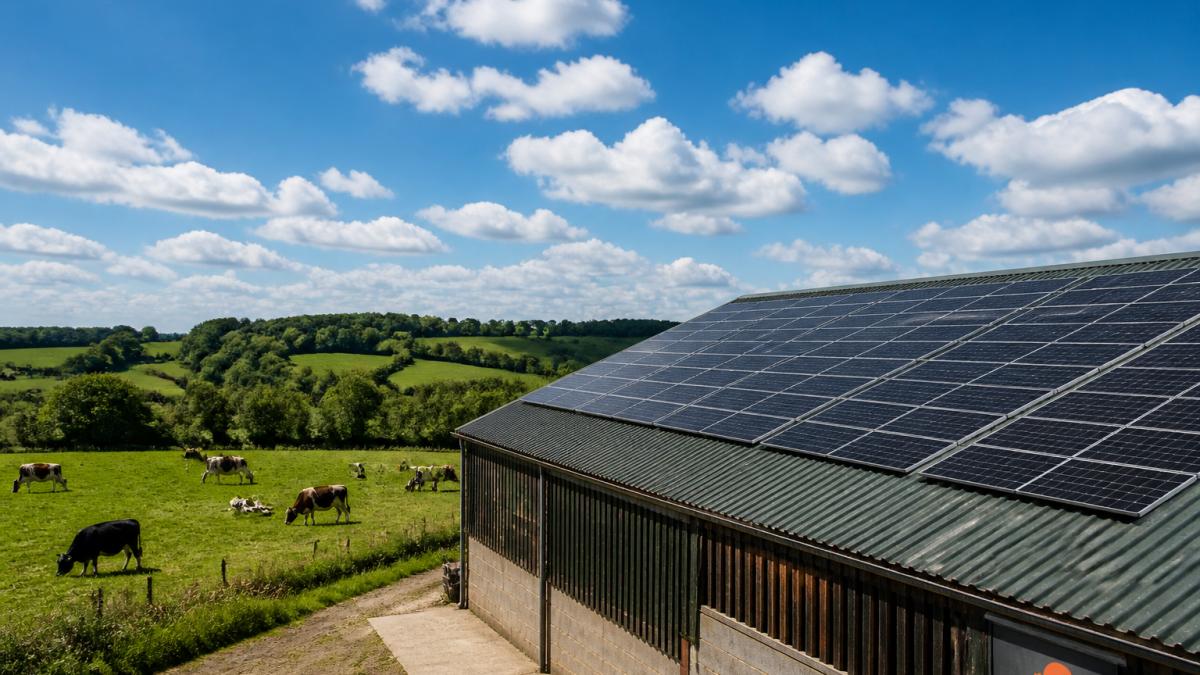
Farm solar installations vary in size depending on operation size and energy demand. The system size determines how much of your energy needs you can meet from solar generation.
Winter presents the only real limitation. Solar output drops significantly during shorter days and cloudier months, though even in winter, panels generate usable power on clear days. This is where battery storage becomes essential.
Wind Turbines for Farms: Generating Electricity from Natural Wind Resources
Wind turbines suit farms with consistent wind exposure and sufficient land. The North West's coastal and elevated locations offer excellent wind resources, and rural farms often sit in positions where buildings or trees don't block prevailing winds.
Small-scale turbines for agricultural businesses are designed specifically for on-site generation. They require sufficient space and wind resources to generate electricity.
The advantage of wind over solar is generation during winter and cloudy periods. When solar output drops, wind often picks up. This complementary pattern, strong solar in summer, strong wind in winter, makes combined solar and wind systems particularly effective for year-round energy independence. A farm with both technologies generates power reliably across all seasons.
Wind turbines do require more planning than solar. They need proper siting away from buildings and obstacles. Local planning considerations apply, though most rural farms find approval straightforward for agricultural use. Installation timescales run longer than solar because turbine work involves specialist engineers and more complex foundations. However, the operational lifespan matches or exceeds solar panels, and maintenance costs remain low for well-designed systems.
Battery Storage for Farms: Maximising Energy Independence and Grid Resilience
Battery storage transforms renewable energy from a useful supplement into genuine energy independence. Without batteries, a farm still draws from the grid whenever solar and wind generation falls short. With batteries, you store excess generation and use it during low-production periods.
For agricultural businesses, battery storage delivers two critical benefits. First, it maximises self-consumption of renewable energy. Instead of exporting cheap surplus power to the grid, you store it for your own use when generation drops. Second, it provides backup power during grid outages.
Farm battery systems vary in size depending on operation size and autonomy requirements. The exact size depends on your peak loads, how long you want to run on batteries alone, and your renewable generation capacity.
Battery technology has matured significantly. Modern lithium systems from manufacturers like Sunsynk and SolaX offer 10+ year lifespans, high round-trip efficiency (90%+), and integrated monitoring.
For farms in Burnley and the surrounding region, battery storage also enables participation in the Smart Export Guarantee. When your system generates more power than you use, you export the surplus to the grid at guaranteed rates.
Smart Export Guarantee eligibility and rates
Modern battery systems offer farms substantial lifespan and efficiency for daily cycling and energy independence.
| Feature | Specification | Note |
|---|---|---|
| Lifespan | 10+ years | Lithium systems from Sunsynk and SolaX |
| Round-trip efficiency | 90%+ | Minimal energy loss during storage cycles |
| Degradation | Minimal with regular use | Designed for daily cycling |
| Primary benefit | Maximised self-consumption | Stores excess renewable generation |
| Secondary benefit | Backup during grid outages | Keeps farm operations running |
| Revenue opportunity | Smart Export Guarantee | Export surplus power at guaranteed rates |
Renewable Energy Grants for Farmers: Funding Your Transition
Capital costs represent the primary barrier to renewable energy adoption for agricultural businesses. Grants and funding schemes reduce this barrier substantially. Several programmes support farm renewable installations across the UK.
The Department for Energy Security and Net Zero funding landscape provides various schemes targeting agricultural renewable energy. Eligibility varies by farm size, location, and operation type. Many grants focus on specific technologies, solar, wind, or energy storage, or on achieving particular efficiency targets.
Local authority schemes sometimes offer additional support. Burnley and surrounding councils occasionally fund renewable projects as part of local carbon reduction targets. Checking with your local authority early can reveal funding opportunities that aren't widely publicised.
Grants typically cover 20-50% of installation costs, though some schemes offer higher percentages for specific project types. The application process requires detailed energy audits, quotes from certified installers, and clear business cases showing project viability.
Beyond grants, farm businesses often qualify for business tax relief on renewable energy investments. Capital allowances and energy-related tax deductions reduce the net cost of installation. Discussing these with your accountant before committing to a project ensures you capture all available financial benefits.
Assessing Your Site and Planning Implementation
Before selecting renewable technologies, you need accurate data about your site's potential. This starts with energy consumption analysis. Review 12 months of electricity bills to understand your usage patterns, peak loads, seasonal variation, and annual consumption.
Solar potential assessment requires roof analysis. Orientation, pitch, shading from trees or structures, and roof condition all affect solar performance. Google Solar API for instant roof assessment provides a free tool that maps your property, calculates available roof area, and estimates annual energy generation.
Wind resource assessment is more complex. Wind speed varies dramatically with height, terrain, and local obstacles. Professional wind surveys measure your site's actual wind speed at proposed turbine height, typically over 3-6 months. This data determines whether wind makes economic sense for your location.
You can start this assessment yourself using renewable energy assessment resources from your site. This tool gives you instant estimates of solar generation potential based on your roof characteristics and location. For wind assessment, you'll need professional input, but understanding your solar potential first helps prioritise your investigation.
Soil conditions matter for ground-mounted systems and turbine foundations. Clay soils in many North West locations support either technology, but site-specific surveys confirm suitability and determine foundation requirements. This affects both cost and installation timeline.
Getting Started with Your Renewable Energy System
The path from idea to operational system typically spans 6-12 months, though this varies by project complexity and system size. Understanding the timeline helps you plan accordingly.
Start with a free energy audit from a certified installer. Understanding realistic timelines for commercial renewable energy installation helps you plan the project phases and prepare for the months ahead.
Once you've decided to proceed, detailed design and planning follow. This includes structural surveys if roof-mounting solar, soil investigations for ground arrays or turbines, and detailed electrical design to integrate your system with existing infrastructure. Planning applications may be required depending on turbine size and local regulations.
Installation itself varies by system size. A 20kW solar roof system might take 2-3 weeks. Larger ground-mounted arrays or wind turbines require longer, sometimes 8-12 weeks. Battery storage integration adds 1-2 weeks.
Commercial Renewable Energy Installation Timeline 2026
Post-installation, your system requires minimal maintenance. Solar panels need occasional cleaning in dusty environments. Wind turbines need annual professional inspections. Battery systems require monitoring but no regular maintenance beyond software updates.
Renewable energy for agricultural businesses transforms how farms manage their most significant controllable operating cost. The combination of solar generation, wind turbines, battery storage, and smart grid integration creates systems that operate independently of grid volatility while generating revenue through the Smart Export Guarantee.
Squirrel Energy specialises in designing exactly these systems for farms across the North West. Our MCS-certified installations and Sunsynk and SolaX partnerships ensure your system meets the highest standards and qualifies for all available funding. Renewable energy for farms and rural businesses outlines the full range of solutions we've deployed for operations like yours.
Frequently Asked Questions
What renewable energy options are available for farms in the UK?
Agricultural businesses can combine solar panels, wind turbines, and battery storage to create integrated renewable energy systems. Solar works well on barn roofs and open land; wind turbines suit exposed rural locations. Battery storage allows farms to use power when the sun isn't shining or wind isn't blowing. Many farms combine all three to maximise energy independence and reduce grid reliance, with systems designed specifically for agricultural operations.
Are solar panels worthwhile for agricultural businesses?
Solar panels typically deliver payback periods of 4-7 years for commercial agricultural systems, making them financially viable for most farm operations. Beyond cost recovery, they provide long-term energy cost reduction, protection against rising electricity prices, and the ability to export surplus power to the grid via the Smart Export Guarantee. Farms with high daytime energy demands for grain drying, milking, or processing see the strongest returns.
Can a farm use wind turbines to generate its own electricity?
Yes. Wind turbines suit farms in exposed rural locations with average wind speeds above 6 metres per second. Smaller farm-scale turbines are more affordable than utility-scale installations and can operate alongside solar panels. Wind generation is often stronger in winter when solar output drops, making the combination effective year-round. Planning permission and site assessment are essential first steps.
How can battery storage help a farm use renewable energy?
Battery storage captures excess power generated during peak production hours and releases it when demand is high or generation is low. This allows farms to reduce grid imports, improve energy self-sufficiency to 90% or higher, and maintain power during grid outages. For livestock operations and temperature-sensitive facilities, battery backup provides critical resilience. Storage also enables farms to maximise revenue through the Smart Export Guarantee by storing and exporting power strategically.
What renewable energy grants are available for farmers?
Several schemes support agricultural renewable energy investment in the UK. The Sustainable Farming Incentive offers payments for environmental and productivity improvements including renewable energy adoption. Rural grants and development programmes vary by region and farming type. Local authority schemes and sector-specific funding also exist. Eligibility depends on farm size, location, and system type. An energy consultant can identify which grants apply to your operation.
Can agricultural businesses sell surplus renewable electricity to the grid?
Yes, through the Smart Export Guarantee (SEG). Farms with solar panels, wind turbines, or battery storage can export unused power to the grid and receive payment from licensed energy suppliers. This creates an additional revenue stream that improves overall system ROI. SEG payments vary by supplier and time of export, making battery storage valuable for timing exports when rates are highest.
