
Last Updated: November 17, 2026
Quick Summary
To choose a solar panel company in Burnley, check its MCS certificate against the official register, confirm electrical competence and insurance, and compare itemised written quotes rather than headline totals. Ask for a site survey and a custom design before committing to any installer.
- Verify MCS certification using the certificate number and the official MCS installer directory.
- Request current public liability and employer's liability insurance certificates before signing anything.
- Compare quotes line by line, including panels, inverter, battery, scaffolding and commissioning.
- Ask each company to state its payback assumptions, including annual usage and export rate, in writing.
- Walk away from any installer that quotes a fixed design without first visiting your site.
Table of Contents
- Why Choosing the Right Solar Panel Company in Burnley Matters
- Checking Solar Panel Installer Qualifications in the UK
- Judging a Proposal: Custom Design, Site Surveys and Roof Suitability
- Comparing Quotes Without Chasing the Lowest Figure
- What a Solar Panel Installation Warranty Should Cover
- Commercial Solar Panels in Burnley: What Businesses and Farms Should Ask
- Booking a Free Survey and Solar Battery Storage Options in Burnley
- Frequently Asked Questions
Why Choosing the Right Solar Panel Company in Burnley Matters
Choosing a solar panel company in Burnley is a bigger decision than most homeowners and business owners expect. A system is usually designed to last 25 years or more, and the quality of the design and installation determines how well it performs for all of that time. A careful first choice of installer protects the people who go through this process.
The sensible starting point is to slow down. Compare installers on the same basis, ask what each one actually proposes for your roof or site, and check the credentials behind their claims. The seven checks below help you do exactly that, whether you are a householder, a farmer or the operations manager of a commercial site.
Checking Solar Panel Installer Qualifications in the UK
Qualifications are the first filter, but the useful part is knowing how to check them rather than simply reading a list. A solar installer working in the United Kingdom should be able to show you recognised certification for its work, and it should be willing to explain what that certification covers. Ask for the details in writing rather than relying on a logo on a website.
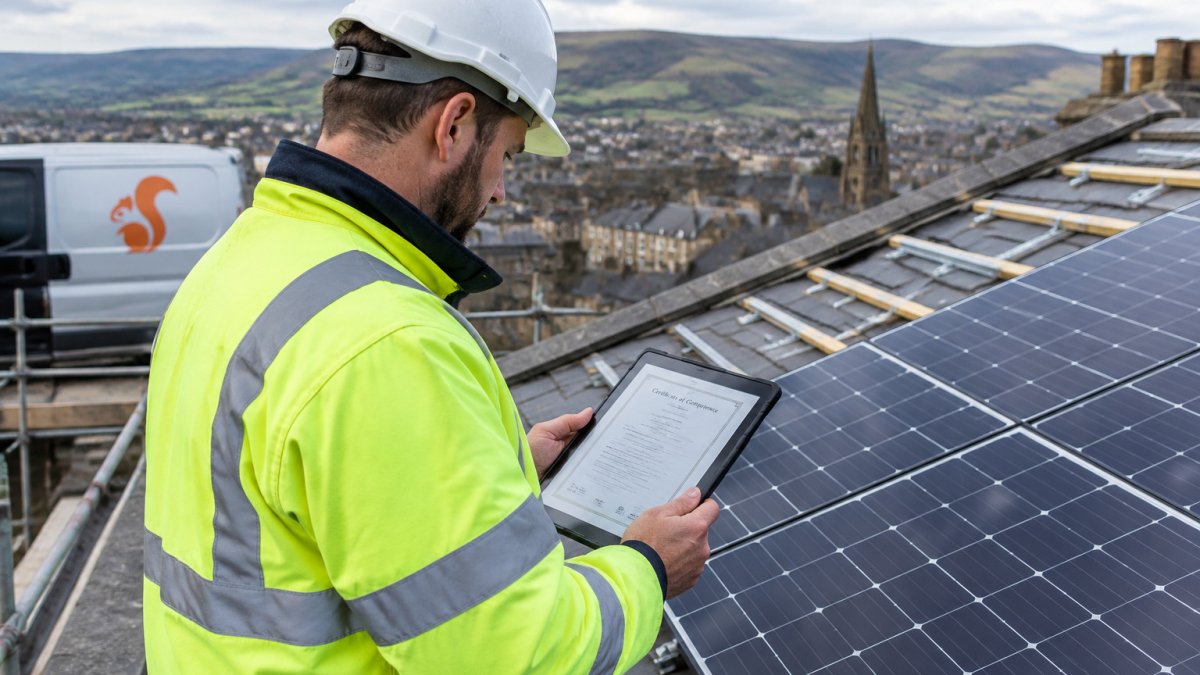
Use this practical vetting checklist when you speak to any company, and keep a copy so you can compare answers side by side:
- MCS certification, ask for the certificate number and the scope it covers (solar PV, battery storage, or both). Check it against the MCS certified installer directory rather than accepting a screenshot.
- Electrical competence, confirm the qualifications of the electricians who will actually connect the system, including any battery storage. Ask whether the work is notified to Building Control under Part P of the Building Regulations (Electrical safety: Approved Document P).
- Insurance, request current public liability and employer's liability certificates. A legitimate installer will send these without hesitation.
- Product approvals, ask for the named models of panels, inverters and batteries, and confirm they appear on the MCS product database or the manufacturer's own approved-installer list.
- Local references, ask for recent jobs of a similar size, and ask whether you may contact those customers.
- Trading history, check how long the company has been trading at Companies House, and look for a consistent local address rather than a virtual office.
MCS Certification and What It Covers
The Microgeneration Certification Scheme, known as MCS, is the quality standard most UK buyers should look for. It certifies the installer and the products it uses, and it underpins many government-backed schemes and grid connection arrangements. Certification does not guarantee a good design, so treat it as a minimum requirement rather than proof of quality.
Ask the company which MCS certificate applies to your job, and confirm that the certificate is current before you sign anything. A company that cannot answer this clearly is telling you something useful.
Verifying Credentials Independently
Do not rely only on what a company tells you. Check its certification and product approvals against the official registers, and ask for references from recent jobs of a similar size. A reputable installer will welcome these checks because it has nothing to hide.
Look at how long the company has been trading, too.
Watch out: a polished quote is not evidence of a current certificate or complete scope. If the certificate number cannot be verified on the official register, or the company is vague about who will sign off the electrical connection, treat that as a reason to walk away rather than a detail to sort out later.
Judging a Proposal: Custom Design, Site Surveys and Roof Suitability
A proposal should reflect your property, not a generic package. Before any design is produced, a competent installer should visit the site, assess the roof or ground conditions, check shading, and confirm how the system will connect to your existing electrical supply. If a company offers a fixed design without seeing the site, treat that as a warning sign.
Roof suitability matters more than many buyers realise. The orientation, pitch, structural condition and shading from nearby buildings or trees all affect how much a system will generate. Grid connection and any planning considerations also need to be checked early, not after the contract is signed.
Ask whether each system is custom designed for your site, and who designed it.
Comparing Quotes Without Chasing the Lowest Figure
Quotes are hard to compare because companies rarely describe their work in the same way. One proposal may include a specific battery model and monitoring, while another quietly leaves them out. Before you compare totals, line the quotes up by component, warranty, installation scope and aftercare, and ask each company to confirm, in writing, what is included and what is excluded.
A quote that is genuinely comparable will itemise the following. If any line is missing, ask for it before you go any further:
- Panels, make, model, wattage and quantity, plus the performance warranty terms.
- Inverter, make, model, rating and warranty, and whether it is string or hybrid.
- Battery storage, capacity in kWh, chemistry, usable capacity and warranty, if one is proposed.
- Mounting and roof works, rail system, flashing, any roof repairs, and who is responsible for making good.
- Electrical scope, cabling runs, consumer unit or distribution board changes, isolators, and commissioning and testing.
- Scaffolding and access, whether it is included, and who arranges it.
- Design and survey, whether a site visit and a custom design are part of the proposal or an extra.
- Aftercare, workmanship warranty length, who handles faults, response times and call-out terms.
Use a simple comparison table to make the differences visible:
| Quote element | What to check | Why it matters |
|---|---|---|
| Panels and inverter | Named models and approvals | Sets performance and warranty |
| Battery storage | Capacity, chemistry and warranty | Affects backup and future upgrades |
| Installation scope | Labour, cabling, consumer unit and commissioning | Reveals hidden extras |
| Warranty and aftercare | Duration, who is responsible, call-out terms | Protects you after handover |
| Design and survey | Whether a site visit and custom design are included | Shows how well the system fits your site |
Payback and savings figures deserve particular scrutiny. A projected payback depends on your actual consumption, roof orientation and shading, electricity prices, export payments and whether a battery is included. Ask each company to state its assumptions explicitly, annual usage in kWh, the electricity price it has used, the assumed export rate and the system's estimated annual generation, so you can see whether the numbers are grounded in your property or borrowed from a generic model.
We never quote prices for our systems, because every installation is custom designed for the property and its energy needs. That also means you should be wary of any company that quotes a headline figure before seeing your site. Ask for a written, itemised proposal and compare the scope, not just the total.
Watch out: the most common trap is a low headline figure that excludes scaffolding, consumer unit upgrades or commissioning, or that assumes an unrealistically high export rate. If a quote cannot be broken down line by line, or the savings assumptions are not written down, you cannot compare it fairly with anything else.
What a Solar Panel Installation Warranty Should Cover
A warranty is only as useful as the company standing behind it. Panels, inverters and batteries usually carry separate manufacturer warranties, and the installer should give you a workmanship warranty on its own work. Ask who handles a claim on each part, how long each warranty lasts and what is excluded.
Aftercare deserves the same attention. Find out what happens if the system develops a fault, who you call, and how quickly a visit can be arranged. A solar installation is a long-term relationship, so the installer's support in five or ten years' time matters as much as the handover day.
Commercial Solar Panels in Burnley: What Businesses and Farms Should Ask
Commercial and agricultural projects carry different questions. Operations managers want to know how a system will affect overheads and whether it can be sized to a specific load profile. Farm owners often need a system that can run with a degree of grid independence for livestock and grain drying. If you are considering wind as well, design a bespoke wind turbine system step by step, from site assessment and planning rules to sizing and a realistic cost breakdown.
When you speak to an installer about commercial solar panels in Burnley, ask how the system will be modelled against your actual consumption, how the business case is calculated, and what assumptions sit behind the payback estimate. Ask whether battery storage or a micro-grid is part of the design, and whether the installer has delivered projects of a similar scale. Treat payback figures as estimates that depend on energy prices, usage patterns and the system's performance over time, and ask for those assumptions in writing.
Many businesses also want to understand how the system fits their existing electrical infrastructure, including any export arrangements. A specialist installer should address these points before recommending a design.
Booking a Free Survey and Solar Battery Storage Options in Burnley
The best next step is a site survey, because it turns general questions into specific answers for your property. Squirrel Energy offers free energy audits and feasibility studies, so you can see what a system could realistically do before you commit. If you are weighing up battery storage, you can also explore our battery storage installation options and see the range of systems we install.
When you are ready to act, request a free survey from our Burnley solar installation team. If you are comparing installers in the area, our free energy audit for solar panels in Nelson follows the same process. For farms and rural businesses, our renewable energy service for farms and rural businesses covers micro-grid systems. Whichever route you take, ask every installer the same questions, compare like with like and insist on a design made for your site.
Frequently Asked Questions
How do I choose a reliable solar panel installer in Burnley?
Start by confirming the installer holds MCS certification and can show an installation record you can check. Ask whether a site survey is included before any design is produced, and whether the system is custom designed for your roof, load and energy use. Request a written proposal that itemises equipment, labour and aftercare, then compare at least three proposals line by line. A reliable installer will answer these questions directly and without pressure, and will be happy for you to verify their credentials independently.
What qualifications should a solar panel installer have in the UK?
The main credential to look for is MCS certification, the Microgeneration Certification Scheme that many UK government-backed incentive schemes depend on. Installers should also hold appropriate electrical qualifications and carry suitable public liability insurance. Check that the company is registered for the Smart Export Guarantee if you want to export surplus electricity. Ask who will design the system and what engineering experience they have, because the design is where most performance problems start.
What should a solar panel installation warranty cover?
A solar panel installation warranty should set out what the installer guarantees for workmanship, such as roof penetrations, cabling and mounting, and for how long. Equipment warranties from panel and inverter manufacturers are separate and usually run for longer, so ask who handles claims. Clarify the response times for faults, whether monitoring is included, and who you call if the system fails in five years' time. Get the terms in writing before you sign.
Do I need battery storage with solar panels in Burnley?
Battery storage is not essential, but it can help you use more of the electricity your panels generate, rather than exporting it at a lower rate. Whether it is worthwhile depends on your daytime and evening usage, the size of the array and your backup power needs. A specialist installer should model both options using your actual consumption data and explain the assumptions behind any savings figures, rather than giving a single optimistic answer.
