
Quick Summary
Microgrid technology for small farms is a self-contained local electricity network that generates, stores and balances power on site, and can run alongside or independently of the national grid. It suits farms wanting more control over their power, backup during outages, and lower dependence on grid electricity.
- Start with a farm energy audit covering twelve months of half-hourly meter data before choosing any equipment.
- Do not size a microgrid from your bills alone, because timing of use decides whether you need storage.
- Battery storage trades capacity against cost, with larger batteries covering more demand after dark.
- Costs depend on system size, site, equipment, grid connection and groundworks, so request a site-specific quote.
- Book a free feasibility study to see whether a microgrid suits your farm and what it could deliver.
Table of Contents
What a Microgrid Is and How It Differs from the Grid
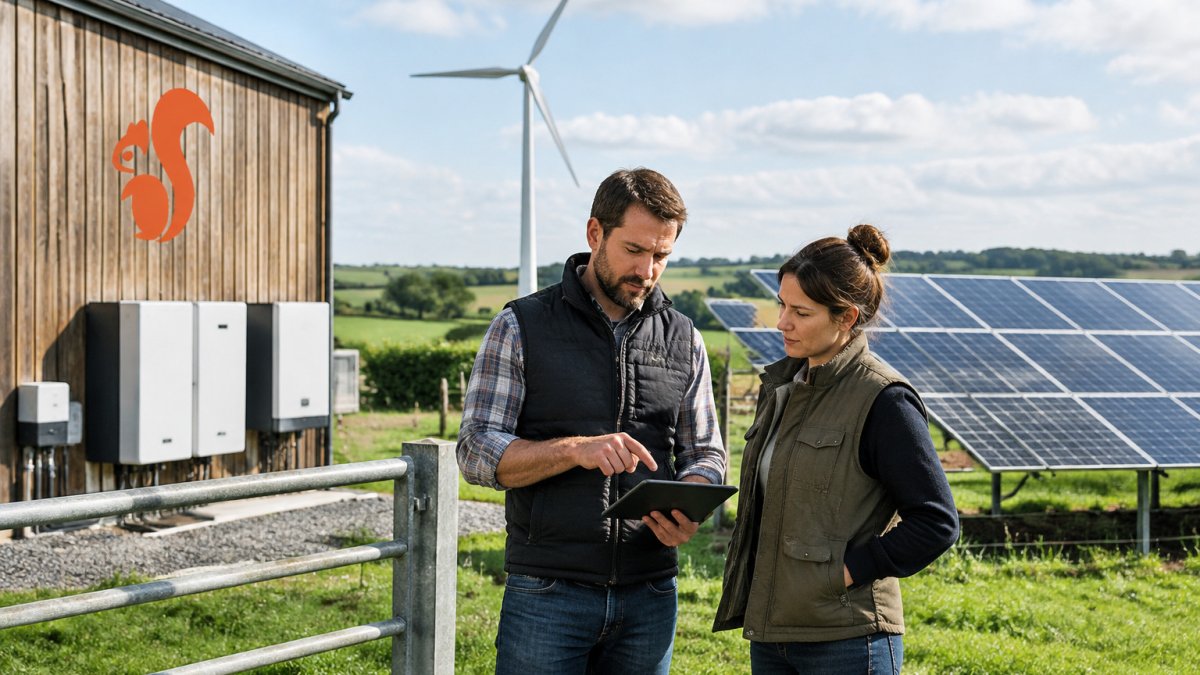
Microgrid technology for small farms is an option for farm owners who want more control over their power. A microgrid is a self-contained local electricity network that can run alongside, or independently of, the national grid (Electricity Policy Review: B9 Energy Group). Squirrel Energy designs and installs bespoke solar, battery and wind systems, integrated with micro-grid technology.
This guide is designed to help you judge whether a microgrid suits your holding. We cover the basics, the energy demand you need to measure, the equipment options, the costs and funding, and the grid and safety rules you must follow.
The grid is a large network that carries electricity from big power stations to homes and businesses over long distances. A microgrid is much smaller. It brings together generation, such as solar panels or a wind turbine, with storage, usually batteries, and a control system that balances supply and demand on site.
The key difference is where the power comes from and where it goes. A conventional farm draws almost everything from the grid. A microgrid generates much of its own electricity, stores the surplus, and can disconnect from the grid during an outage. Farm micro grid systems show how solar, wind, battery and backup generation work together in one system.
Microgrid operation is not all-or-nothing. Island mode, where the farm runs entirely on its own supply, is available only where the system is designed for it.
Watch out: Do not size a microgrid from your bills alone. Bills show what you pay, not when you use power, and that timing decides whether you need storage.
Working Out Your Farm's Energy Demand with a Farm Energy Audit
Before choosing any equipment, you need to know how much electricity your farm uses and when. A farm energy audit gives you that picture. It records your consumption by hour, day and season, and it identifies the loads that matter most, such as grain drying, milking, ventilation, water pumping and cold storage. How a renewable energy site survey works explains what the assessment involves.
Start with twelve months of half-hourly meter data where your supplier can provide it. Add the nameplate ratings of your major machines. The audit then shows your peak demand, the highest draw you need to cover, and your base load, the power you use around the clock.
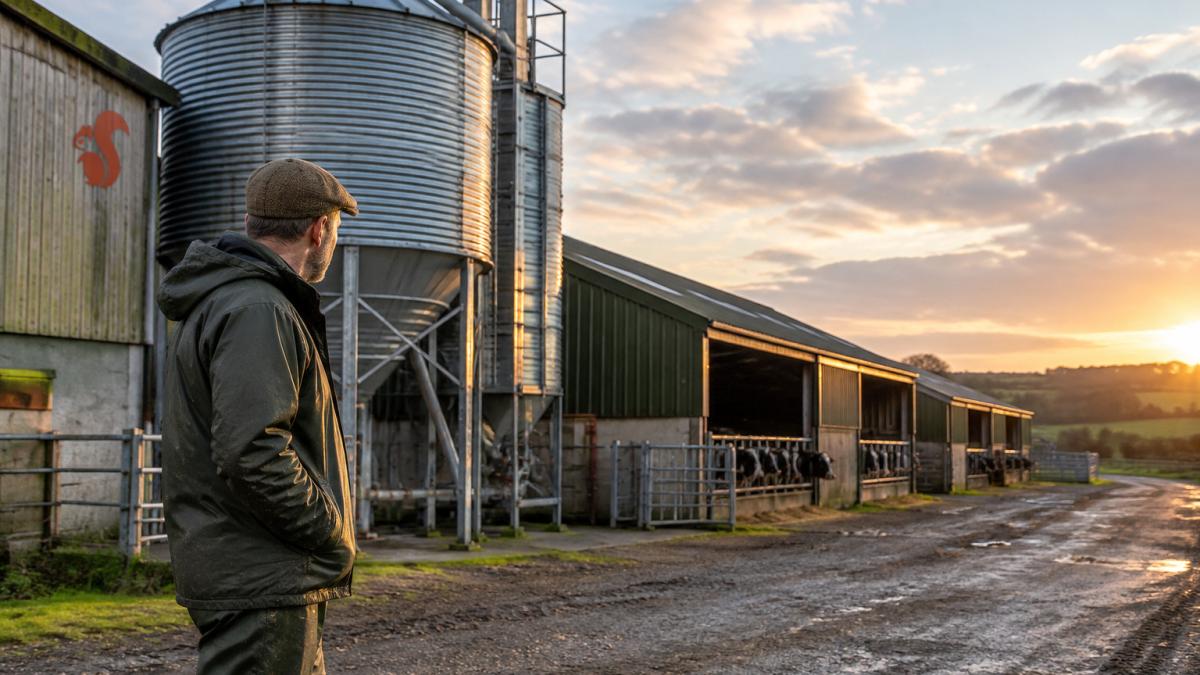
A farm with heavy drying in autumn needs a different design from a dairy unit with steady daily demand.
Choosing Solar Panels for Farms and Battery Storage for Farms
Solar is usually the first generation source to consider, because barn roofs and open land often provide suitable space. The right size depends on your roof orientation, shading, available land and the output you need. Ground-mounted arrays suit farms with spare land, while barn roofs suit holdings where the structure is sound and well positioned.
Panel choice matters less than system design. The inverters, controls and connection arrangement determine how well the solar output works with your load. Squirrel Energy works with Sunsynk and SolaX equipment.
Battery Storage for Farms: Sizing and Trade-offs
Batteries store daytime solar surplus for use in the evening or during cloudy periods. They also provide backup during a grid outage. The main trade-off is capacity against cost. A larger battery covers more of your demand after dark but adds to the upfront investment.
Microgrid Costs for Farms, Payback and Funding in the UK
Costs vary too much between farms for us to quote a standard price. Pricing depends on the size of the system, the site, the equipment specification, the grid connection work and any groundworks. Please contact Squirrel Energy directly for a quote based on your site and energy data.
Payback depends on how much of your generation you use yourself, the value of any exports, and your current tariffs. Payback is confirmed during a feasibility study, and assumptions can be set out for your farm at that stage.
Funding options and grants change over time, so check current schemes before committing. The Smart Export Guarantee is one route to earning income from exported electricity, and Squirrel Energy is registered under the Smart Export Guarantee.
Best for: farms with high daytime demand and an interest in long-term energy independence. Skip if: your power use is low and steady, with no plans to expand or change how the farm runs.
Grid Connection, Safety and Backup Power Requirements
Any system connected to the grid must follow the rules set by your Distribution Network Operator and the relevant UK standards. Check these requirements early, because grid connection can add time and cost to a project.
Backup power is one of the strongest reasons for a microgrid on a working farm. During an outage, a correctly designed system can keep essential loads running. Confirm with your installer which circuits will be covered and how the system switches over.
Booking a Feasibility Study for Your Farm
The best next step is a feasibility study. Squirrel Energy offers free energy audits and feasibility studies. You will leave with a clear view of whether a microgrid suits your farm and what it could deliver.
Get started with Squirrel Energy and find out how much of your farm's power you could generate and store for yourself.
Frequently Asked Questions
What is a microgrid on a small farm?
A microgrid on a small farm is a self-contained electricity network that combines local generation, usually solar photovoltaic panels, with battery storage and an energy management system. It can run alongside the public grid, which is grid-connected operation, or disconnect and supply the farm alone during an outage, known as island mode. For most small farms the aim is to cut purchased electricity, keep irrigation pumps and milking or grain drying running, and provide backup power when the grid fails.
How much does a microgrid cost for a small farm in the UK?
Squirrel Energy has not published fixed prices, and cost depends on the farm's load profile, roof or land suitability, battery size and grid connection work. The best starting point is a free energy audit and feasibility study, which gives a site-specific quote. Compare any quote against the audited annual electricity bill and the expected generation to judge payback. Ask for the quote to show the battery size, the expected self-consumption and any Smart Export Guarantee income assumed.
Can a farm microgrid operate during a power cut?
Yes, if the system is designed for island mode. A correctly specified battery and inverter can keep essential loads such as water pumps, ventilation and refrigeration running during a grid outage. Not every system is built this way, so confirm with the installer that the inverter supports islanding and which circuits are on the backed-up supply. Check the battery sizing against the critical load you need to hold for the longest typical outage.
Do solar panels for farms need MCS certification?
For systems that qualify for government-backed incentives and for many grid connection applications, installation by an MCS-certified installer is the standard to look for. Squirrel Energy is an MCS-certified installer and uses Sunsynk and SolaX approved equipment. Ask any installer for their MCS certificate number before you agree a contract, and confirm that the system design, including any battery, is covered by the certification.
