
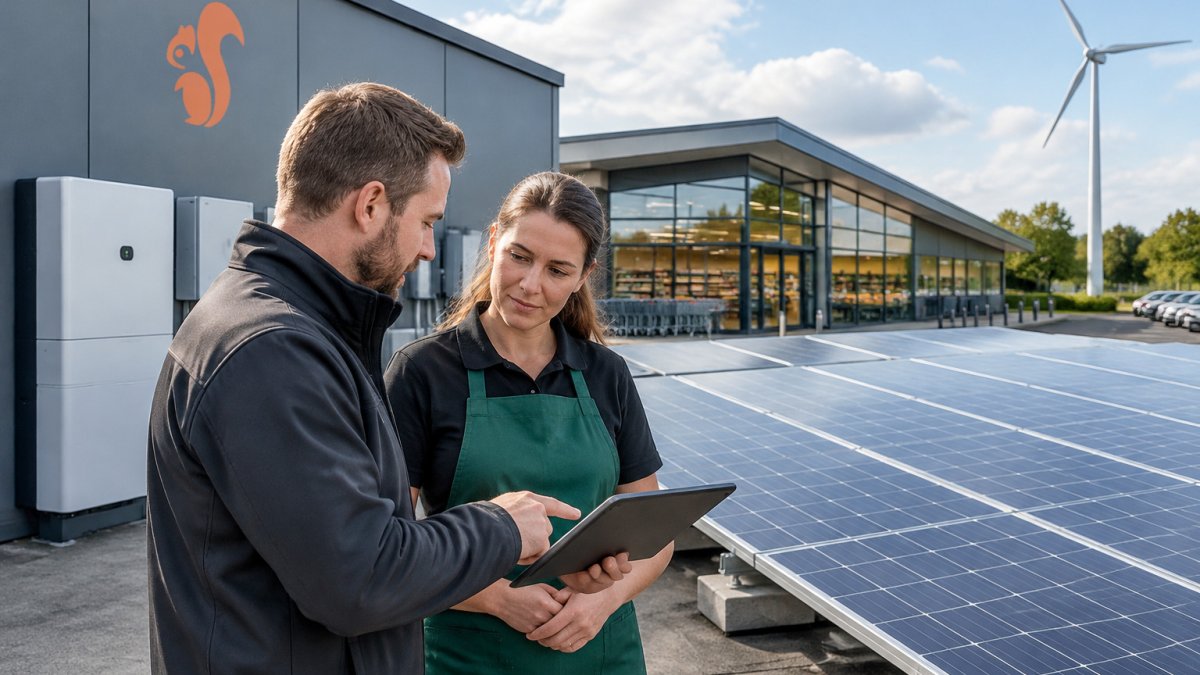
Last Updated: November 15, 2026
Quick Summary
Renewable energy retail investments can pay off for shops and showrooms with large roofs and steady daytime electricity use, because solar generation matches trading hours. Shaded roofs, short leases or evening-only trading make the case weaker and need careful modelling before committing.
- Daytime demand from lighting, refrigeration and tills often lines up well with solar generation.
- Battery storage makes most sense for sites trading into the evening or with a high base load.
- Confirm the roof's structural condition and membrane before designing any solar array.
- Start the grid connection application early, as the DNO process often takes longer than expected.
- A free energy audit and feasibility study shows whether solar, storage or a combination suits your premises.
Table of Contents
- Why Retail Outlets Are Turning to Renewable Energy
- Renewable Energy Options Suited to Retail Buildings
- Commercial Solar Panels for Retail: Roof Suitability and Output
- Battery Storage for Businesses: Making Daytime Generation Work Harder
- Commercial Solar Return on Investment: How Retailers Assess the Business Case
- Commercial Grid Connection Applications and Project Timelines
- Deciding Whether to Manage the Project In-House or Use a Specialist Installer
- Booking a Free Energy Audit and Feasibility Study for Your Store
- Frequently Asked Questions
Why Retail Outlets Are Turning to Renewable Energy
Renewable energy for retail outlets is no longer a niche concern for sustainability teams. For a shop, retail unit or showroom, electricity is a fixed operating cost that rises with every tariff review, and the businesses that take control of it protect their margins. Squirrel Energy designs and installs commercial solar and battery systems for retail premises.
The answer depends on how the building uses power. Retail sites typically run lighting, refrigeration, heating and ventilation, and tills through trading hours, so daytime demand often lines up well with solar generation. Where a unit has a large roof and a steady daytime load, the economics can be strong. Where the roof is shaded, the lease is short or trading is mostly evening, the case is weaker and needs more careful modelling.
We would rather you understand that trade-off before you speak to any installer, ours included. The rest of this guide covers the options, roof and grid questions, the financial case and the practical steps to take next.
Renewable Energy Options Suited to Retail Buildings
Within renewable energy retail, premises in Burnley and across the UK have a narrower set of genuinely practical options than sector-wide marketing suggests.
Solar photovoltaic (PV) generation remains the default for most retail sites.
Battery storage is the natural companion for sites that trade into the evening or carry a high base load from refrigeration and display lighting.
Air source heat pumps are increasingly relevant where retail premises have significant space heating or hot water demand, such as garden centres, farm shops and larger showrooms.
Off-site renewable electricity procurement, a renewable tariff or a corporate power purchase agreement, is the fallback for businesses without a suitable roof, such as tenants in multi-storey units, listed buildings or heavily shaded sites.
Demand response and flexibility services suit larger sites with controllable loads.
Wind and other generation technologies are rarely appropriate for a retail park or high street unit because space, noise and planning requirements are difficult to meet in a typical trading location.
| Option | Best suited to | Main constraint |
|---|---|---|
| Rooftop solar PV | Large flat or lightly pitched roofs with daytime load | Roof condition, shading, structural capacity |
| Solar plus battery | Sites trading into the evening or with high base load | Upfront cost, battery lifespan |
| Air source heat pump | Sites with significant space heating or hot water demand | Building fabric, emitter sizing, separate assessment |
| Off-site renewable tariff or PPA | Tenants, multi-storey, listed or heavily shaded units | No on-site generation, less cost control |
| Demand response | Larger sites with controllable loads | Eligibility rules, administrative burden |
| Combined approach | Sites with partial roof access and mixed demand | Needs careful design to avoid overbuilding |
For Burnley retailers, the choice is often shaped by property factors as much as technology.
Commercial Solar Panels for Retail: Roof Suitability and Output
The first question for any retail roof is whether it can carry the load and receive enough sun to justify the system. A structural survey is essential, particularly on older or converted buildings. Roof membrane condition also matters, because fitting panels over a roof that needs replacing within a few years adds cost and disruption.
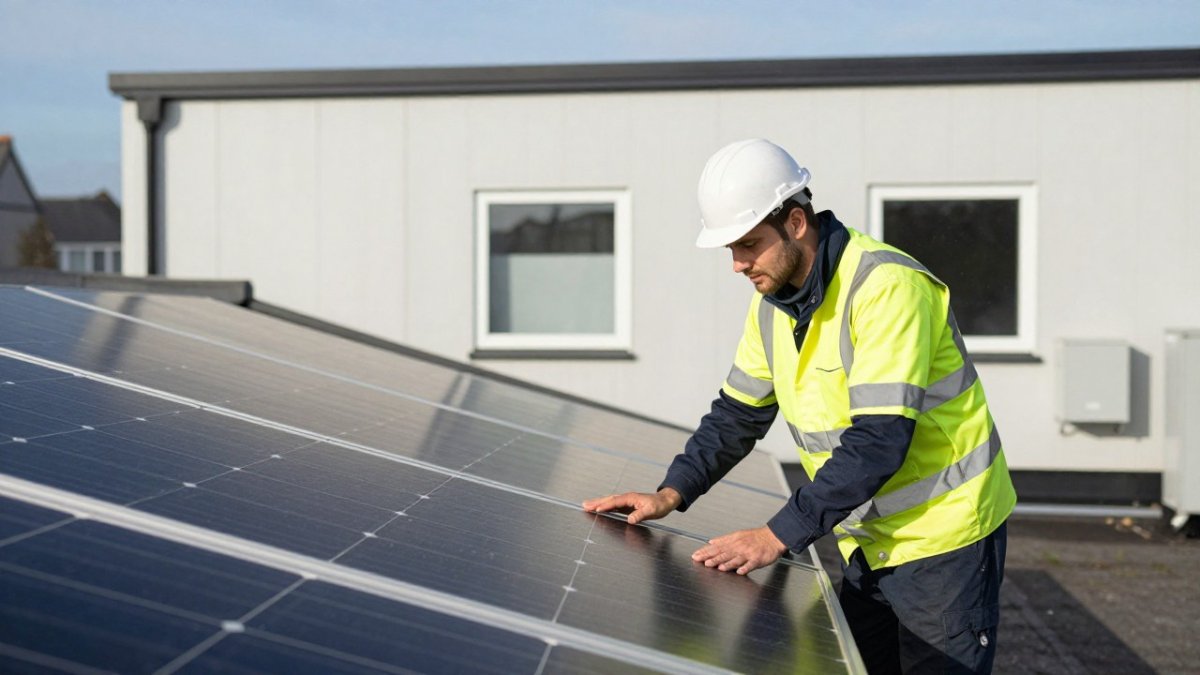
Orientation and shading decide most of the output. A south-facing roof with no nearby obstructions is ideal in the UK, though east and west orientations can still perform well when the load profile suits them.
We design each system around the specific roof rather than applying a standard layout. Panel count, inverter sizing and electrical connection depend on the building's demand, the roof area available and the grid connection. If you are unsure whether your roof is suitable, a free energy audit is the sensible starting point.
Watch out: a roof that looks ideal from ground level may have a structural limit or a failing membrane that only shows up on inspection. Check both before committing to a design.
Battery Storage for Businesses: Making Daytime Generation Work Harder
Solar generation peaks in the middle of the day, but many retail sites need the most power at other times, such as early mornings, late afternoons and evenings. Battery storage captures surplus daytime electricity and releases it when the building needs it, increasing the share of generation actually used on site.
This matters most for businesses with long trading hours or high base loads from refrigeration and lighting. Without storage, surplus solar is typically exported at a lower rate, so the more you consume on site, the better the financial return.
Battery support deserves as much attention as the hardware. Our commercial battery storage ROI review sets out payback periods, cost factors and revenue streams before you invest. Our guide to what battery storage support should include covers these questions in more detail.
We size batteries against the building's actual consumption pattern. A larger battery is not automatically better; an oversized unit adds cost without a matching return if the site cannot use the stored energy.
Commercial Solar Return on Investment: How Retailers Assess the Business Case
Return on investment is the question most finance teams ask first, and it is reasonable to ask it. Payback depends on system cost, the share of generation used on site, the electricity tariff, any available allowances and the export arrangements that apply. You can work through the steps to calculate solar payback and return using your own figures. Because these vary from site to site, we do not publish a single price or payback figure, and anyone quoting one without a site survey should be treated with caution.
Assessment models the building's real consumption, the roof's real output and the tariff the business actually pays, then calculates payback and returns for that specific case. Payback periods vary considerably from site to site, and any figure should be confirmed against a site-specific assessment.
The Smart Export Guarantee is one part of the picture for surplus generation. It sets out how generators can be paid for electricity exported to the grid, and the rate varies between suppliers (Smart Export Guarantee (SEG)). Tax treatment, capital allowances and any grants also change the calculation, so check the current position with your accountant when you build the business case.
To structure your own assessment, work through these steps:
- Pull twelve months of half-hourly or monthly electricity consumption data
- Identify the share of demand that falls during daylight hours
- Confirm the roof's usable area, structural condition and orientation
- Obtain a site-specific design and cost from a qualified installer
- Calculate payback using the actual tariff, export rate and allowances that apply
Commercial Grid Connection Applications and Project Timelines
Connecting a commercial solar system to the grid is a regulated process, and the timeline is often longer than store owners expect.
Early application matters. The earlier you begin the grid connection process, the less likely the project will be held up at the connection stage. We recommend raising the grid question during the initial survey so design and application proceed together.
Project timelines depend on the system size, the DNO's processing time and the complexity of the site. A well-run project typically moves through the following stages, though the duration of each varies:
- Energy audit and feasibility study to establish demand, roof suitability and the likely system size
- Roof and structural survey, including membrane condition and any asbestos or access constraints
- Grid connection application and DNO response, including any export limitation or reinforcement requirement
- Detailed electrical design, including inverter sizing, protection and metering
- Planning permission check where the building is listed, in a conservation area or subject to other local constraints
- Installation, commissioning and handover, including certification and monitoring setup
- Ongoing monitoring, maintenance and performance review
Ask any installer to set out these stages from survey to handover, including the grid application, so you can plan trading around any disruption. A well-run project should explain each stage clearly and tell you which are on the critical path.
Watch out: a DNO may impose an export limitation rather than approve the full export capacity, which can change the battery and inverter design and the financial case. Confirm the connection outcome before finalising the equipment specification.
For leased premises, the grid application usually requires the landlord's consent and may need to be made in the landlord's name or with their authority. Clarify this early, because delayed consent can hold up the entire programme.
Deciding Whether to Manage the Project In-House or Use a Specialist Installer
Some businesses, particularly farms and larger operators with in-house engineering capability, prefer to manage parts of a project themselves. If you would rather not fund the system upfront, you can explore commercial solar with no capital investment through a power purchase agreement.
The risks lie in the technical design and compliance work. Electrical design, grid connection applications, structural assessment and certification need to be right the first time, and mistakes can be expensive to correct, both in performance and in warranty terms. A specialist installer carries that responsibility and can show the design basis for every decision.
Our systems are custom designed by electrical engineers with over 40 years of experience. The value for most retail clients is not just the installation but the assurance that the system performs as modelled and that someone is accountable when it does not.
If you do plan to take on part of the work, agree clearly which tasks you will handle and which the installer will carry out, and make sure the design and warranty responsibilities are documented in writing.
Booking a Free Energy Audit and Feasibility Study for Your Store
The most useful next step for most retail operators is a free energy audit and feasibility study. We look at your electricity consumption, your roof and site conditions, and your grid connection, then tell you honestly whether solar, battery storage or a combination makes sense for your premises. If the numbers do not stack up, we will say so.
The audit gives you a clear basis for the business case, whether you proceed with us or another provider. It also surfaces practical issues early, including structural limits, shading, grid constraints and the likely timeline, so you can plan trading around the work.
Contact Squirrel Energy to request your free energy audit and feasibility study. You can also find out more about commercial solar and battery storage installation across Lancashire, Yorkshire and the North West.
Squirrel Energy designs commercial solar and battery systems for retail premises. Our team of electrical engineers provides a custom assessment for every site, with a premium service from survey through to ongoing support.
Frequently Asked Questions
What renewable energy options are suitable for retail outlets?
Most retail outlets start with rooftop solar photovoltaic (PV) panels, because they generate electricity during trading hours when shops use the most power. Battery storage can hold surplus daytime generation for evening use, and some sites add heat pumps or electric vehicle charging points. Off-site renewable electricity contracts are another route, though they do not reduce on-site consumption. The right mix depends on roof condition, shading, grid connection capacity and how the building is used. A site survey by a qualified installer is the reliable way to confirm what fits.
Can solar panels power a retail outlet?
Solar panels can supply a large share of a retail outlet's daytime electricity, but rarely all of it, particularly in winter when UK generation is lower. The share covered depends on roof area and orientation, the building's load profile, and whether battery storage is added. Any surplus can be exported to the grid under the Smart Export Guarantee, provided the installation is registered.
How does grid connection affect a commercial renewable energy project?
Larger commercial systems usually need a formal grid connection application to the local distribution network operator before they can be energised. Connection capacity, network reinforcement and the timescale for approval can all affect the project programme and cost. Applying early helps identify constraints before equipment is ordered.
