
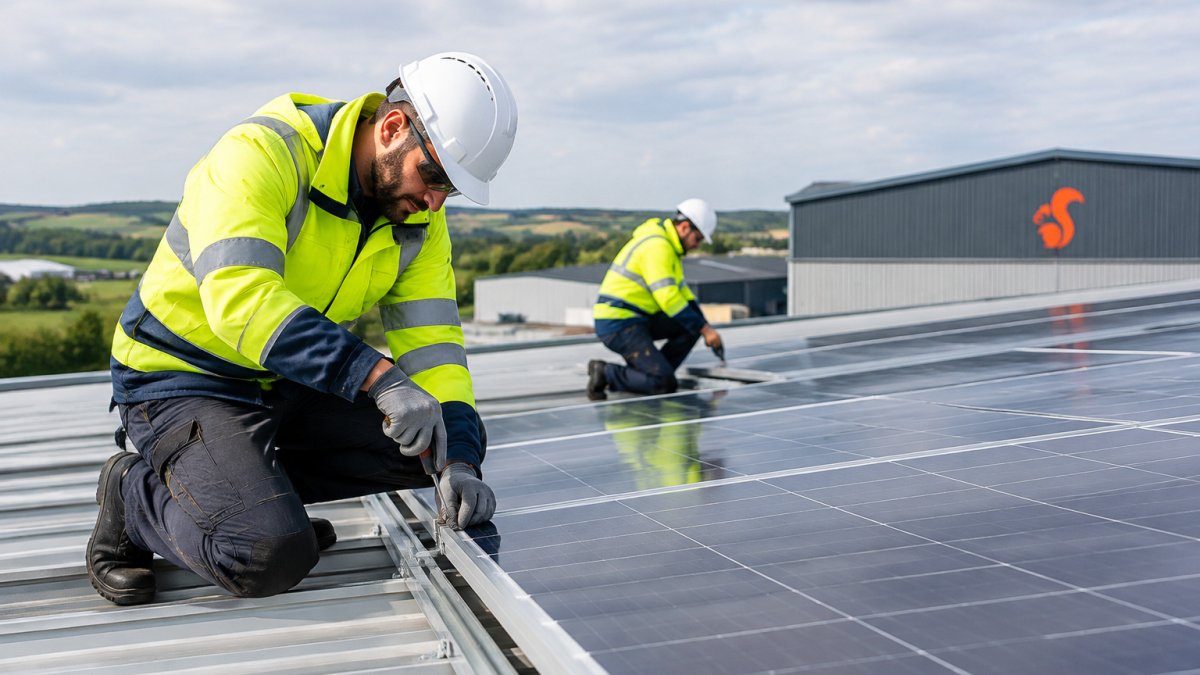
Last Updated: 14 November 2026
Quick Summary
An industrial solar panel installation is a custom-engineered photovoltaic array, mounted and wired on a commercial or agricultural building and sized to that site's energy use rather than a standard kit. The process starts with a hands-on site survey covering the roof, structure, electrical capacity and half-hourly energy demand.
- A standard kit assumes a generic roof and load, which most commercial sites do not have.
- Surveys should check roof type, structural capacity, asbestos status and electrical infrastructure before design begins.
- Match the system to daytime demand, since a site that uses most of its output on site gains more value.
- Confirm lead times for panels, inverters and batteries in writing, as they drive the programme.
- Check MCS certification and Smart Export Guarantee registration before committing to an installer.
Table of Contents
- Why Industrial Solar Needs Engineered Design Rather Than a Standard Kit
- Commercial Solar Site Survey: What Your Installer Should Assess
- The Commercial Solar Panel Installation Process, Stage by Stage
- Connecting Industrial Solar Panels to Existing Diesel Generators
- Industrial Solar Battery Storage and Sizing Considerations
- Permissions, Grid Connection and Compliance in the UK
- Maintaining Your Industrial Solar System and Planning Your First Step with Squirrel Energy
- Frequently Asked Questions
Why Industrial Solar Needs Engineered Design Rather Than a Standard Kit
Industrial solar is not a scaled-up version of a domestic rooftop job. Businesses wanting a system designed for their own site can explore commercial solar panel and battery storage installation across Lancashire, Yorkshire and the North West.
Industrial solar panel installation is the process of designing, mounting, wiring and commissioning a photovoltaic array on a commercial or agricultural building, sized to that building's energy profile rather than a catalogue default.
Several factors make engineered design essential for industrial sites:
- Structural limits: Large commercial roofs often have older steel purlins, mixed roof sheeting or uneven load capacity that a kit never considers.
- Electrical architecture: Three-phase supplies, existing switchgear and any backup generation all shape how the inverters should be configured.
- Operational patterns: A plant running heavy machinery during the day needs a different export and self-consumption strategy from a warehouse that runs mainly at night.
A standard kit may look cheaper on paper, but it can leave export capacity, roof space or battery potential on the table.
Commercial Solar Site Survey: What Your Installer Should Assess
A proper site survey is the foundation of any industrial installation. You can learn more about how a renewable energy site survey works before comparing it with the free energy audit on offer.
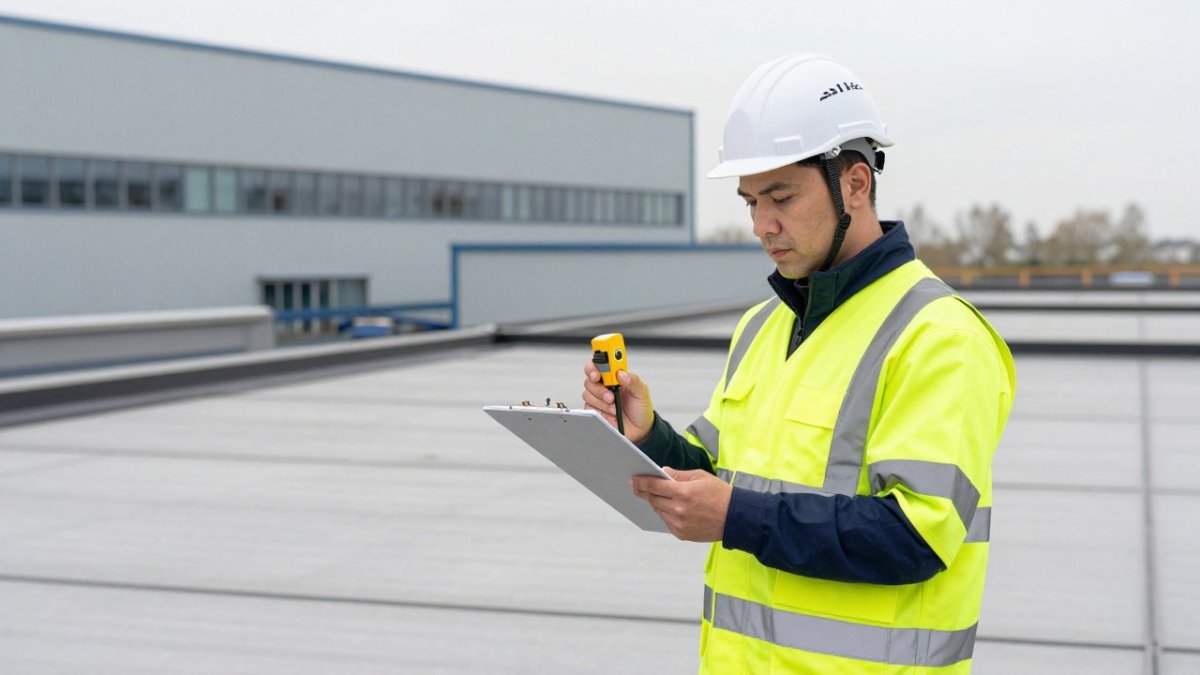
Expect the survey to cover roof condition, structural capacity, electrical infrastructure and your energy use. The sections below set out what each part should involve, with the industrial roof realities that separate a competent survey from a box-ticking one.
Roof Condition, Structural Loading and Roof Type
The roof is the first thing to assess, because everything else depends on it.
Profiled metal sheet roofs are common on warehouses and agricultural buildings.
Built-up felt and single-ply membrane roofs are common on factories and older commercial premises.
Asbestos-containing roofs remain present on many older industrial and agricultural buildings.
Fragile and ageing roofs are a safety and cost issue as much as a structural one.
Structural loading matters just as much.
Energy Use Audit and Load Profile
The energy audit tells you how much of the generated power you can use on site, which drives both the system size and the financial case.
Ask the surveyor to build a load profile showing when your site draws the most power. A factory running a shift pattern, a farm with grain drying in autumn and a warehouse with refrigeration all produce very different shapes, and each shape points to a different design choice.
Electrical Infrastructure and Connection Capacity
The survey should confirm the capacity of the existing supply, the spare ways in the distribution boards and switchgear, and the protection settings. On three-phase industrial supplies, the surveyor should check phase balance and whether the existing earthing and bonding arrangements are adequate for the inverter installation. Where backup generators are present, the surveyor should record how they are connected and how the solar system will coordinate with them.
Site Access, Logistics and Continuity
Finally, the survey should record how materials and plant will reach the roof, where the crane or telehandler can stand, and which production areas can be worked around without shutting the site down. For live industrial premises, these practical details often determine the programme as much as the technical design does.
The survey covers several distinct areas, and the table below summarises what each should confirm before any design work begins.
| Area | What to confirm | Industrial note |
|---|---|---|
| Roof condition | Sheet type, covering and age | Replace an ageing roof before panels go on |
| Structural loading | Purlin and rafter capacity | Check for corrosion at steel connections |
| Asbestos | Asbestos register status | Survey before any planned work |
| Energy use | Half-hourly load profile | Match output to daytime demand |
| Electrical capacity | Supply, spare ways, earthing | Check phase balance on three-phase supplies |
| Site access | Crane position and roof zones | Phase work around production shifts |
The Commercial Solar Panel Installation Process, Stage by Stage
Industrial installations follow a sequence, and understanding it helps you plan around your operations. A typical project moves from survey and design through procurement, mechanical and electrical installation, and finally commissioning and handover. Each stage should have a clear owner and a written schedule. The strongest industrial projects also treat business continuity as a design input from day one, not an afterthought once the crane arrives.
Stage 1: Detailed Survey and Feasibility
The surveyor should be on the roof, in the electrical room and reviewing half-hourly consumption data. Outputs include a roof plan with fixing zones, a structural loading assessment, a single-line electrical diagram and a load profile. These documents also help test how the proposed solar system fits the site’s wider resilience plans, including the electrical measures Bright Sparx Electrical can help assess.
Stage 2: System Design and Approval
The design fixes the array layout, inverter selection and string configuration, the grid connection strategy and any battery or generator integration. It should also set out the construction phase plan, the health and safety arrangements for working at height, and the site-specific access and segregation rules. Sign-off at this stage is your last cheap opportunity to change the scope.
Stage 3: Procurement and Lead Times
Long-lead items, panels, inverters, mounting rails, switchgear and batteries, drive the programme. Ask your installer to confirm lead times in writing and to identify which items could delay the start date. Cash-constrained businesses can also look at zero upfront cost commercial solar through a power purchase agreement. For agricultural clients who want to do some of the enabling work themselves, agree in advance which tasks sit with you and which sit with the installer, so warranties and sign-offs remain clean.
Stage 4: Mechanical Installation
This covers roof access, material handling, mounting rail installation and panel lifting. On live industrial sites the practical questions are: where will the crane or telehandler stand, which roof zones can be worked without closing production, and how will deliveries be booked in around shift patterns?
Watch out: if the roof covering is fragile, asbestos-containing or at the end of its life, mechanical installation can turn into an unplanned roof replacement. Confirm the roof condition and any asbestos register before the programme is fixed.
Stage 5: Electrical Installation
DC cabling, string combiner boxes, inverter installation, AC cabling and connection to the existing distribution board or switchgear. On three-phase industrial supplies this is where the existing electrical architecture matters most: spare capacity, protection settings and any backup generation all shape the final configuration. Ask how the installer will isolate and prove dead the circuits they work on, and how they will coordinate any planned shutdowns with your operations team.
Stage 6: Testing, Commissioning and Handover
Commissioning covers insulation resistance and polarity testing, inverter configuration, grid protection settings, and verification that the array performs as designed under load. Handover should include as-built drawings, test certificates, the operation and maintenance manual, monitoring access and a walkthrough with your site team. Ask for the performance forecast in writing so you can verify actual generation against it in the first year.
Stage 7: Post-Handover Support
A premium installation does not end at handover. Confirm the fault response arrangements, the monitoring alerts, the maintenance schedule and who is responsible for what. For clients who want a single accountable partner across design, installation and ongoing support, that continuity is one of the clearest reasons to engage a specialist installer rather than piecing the project together from separate trades.
Connecting Industrial Solar Panels to Existing Diesel Generators
Many industrial and agricultural sites already have diesel generators for backup or peak supply, and combining them with solar needs careful design. Solar output varies with cloud cover and time of day, so the system has to coordinate with the generator to avoid running the generator inefficiently or overloading the supply when the two sources overlap.
The main questions to settle are how the inverters will synchronise with the generator, whether a battery will smooth the transition between the two, and how the control system will decide which source to use.
Industrial Solar Battery Storage and Sizing Considerations
Battery storage lets a site store surplus daytime generation and use it in the evening, during outages or during peak tariff periods. Sizing the battery is a balance between the energy you can shift, the power you need at any moment and the budget available.
Ask how the battery will be sized against your load profile rather than a rule of thumb. Before signing, review what commercial battery storage support should include, such as maintenance visits and fault response times.
Permissions, Grid Connection and Compliance in the UK
Industrial solar sits within a set of UK requirements, and your installer should manage them as part of the project.
Grid connection is handled with your local distribution network operator. Connection applications can take time, and the export capacity you are granted will affect the design, so raise this early. Ask your installer to take responsibility for the application and to keep you informed of its progress.
Maintaining Your Industrial Solar System and Planning Your First Step with Squirrel Energy
A commercial array needs routine inspection, cleaning where the site requires it, and monitoring to catch faults early. Ask whether the system includes performance monitoring that alerts you to underperformance, and what the maintenance schedule and fault response looks like after handover.
If you are considering industrial solar, your first step is a site survey. Squirrel Energy offers free energy audits and feasibility studies, and every system is custom designed around your roof, your load and your operations.
Frequently Asked Questions
How are solar panels installed on an industrial building?
Installation on an industrial building typically begins with a structural assessment of the roof, followed by mounting system fitting, panel placement, and electrical connection to the site's distribution board. Work is carried out in stages so that daily operations can continue, with access, lifting and safety controls planned in advance. Because every roof has different loading limits, load-bearing capacity and roof covering, the mounting design must be engineered for the specific building rather than chosen from a generic kit. Squirrel Energy designs each system around the individual site, so the method used reflects the roof and the energy demand rather than a standard template.
What should an industrial solar site survey include?
A commercial solar site survey should cover the roof condition and type, its structural capacity to carry panels and mounting frames, available unshaded area, and orientation. It should also include an energy use audit, which looks at when and how much electricity the site consumes, so the system can be sized to match. Electrical infrastructure, such as the main supply capacity and distribution board, needs checking alongside the grid connection requirements. A thorough survey gives the installer the information needed to produce a custom design and a realistic business case for the project.
Can industrial solar panels work with an existing diesel generator?
Yes, solar panels can be integrated with an existing diesel generator, but the control arrangement needs careful engineering. The system must prevent the generator and the solar inverters from working against each other and must manage switchover during an outage. Integration reduces diesel running hours and fuel use, and the generator remains available as a backup. The correct approach depends on the generator's controls, the inverter specification and the site's electrical layout, so it should be designed by an electrical engineer.
What permissions and grid approvals may be needed for industrial solar in the UK?
Industrial solar projects in the UK may need planning permission, depending on the building, its location and the scale of the installation, and building regulations apply to structural and electrical work. Systems connected to the grid require approval from the local distribution network operator before they are energised, and the size of the system determines the process used. Compliance with the relevant electrical standards and the installer's accreditation are also important. Squirrel Energy is MCS certified and registered under the Smart Export Guarantee, and can advise on the approvals relevant to a specific site.
How long does a commercial solar panel installation take?
The timescale depends on the size of the system, the complexity of the roof, the grid connection process and the amount of work needed to keep the site operating. The survey, design, approvals and procurement stages often take longer than the physical installation itself. Planning the work around business operations can reduce disruption during the switchover. Squirrel Energy can provide a project timeline once the site has been surveyed.
How should an industrial solar PV system be maintained?
Regular maintenance includes visual inspection of panels, mounting and cabling, cleaning where dirt or debris reduces output, and checking inverter performance and error logs. Performance monitoring helps identify drops in generation early, which can point to shading, soiling or equipment faults. Batteries, where fitted, need checks on their condition and management system. A maintenance schedule agreed at handover keeps the system operating efficiently over its working life.
Is battery storage useful with industrial solar panels?
Battery storage can increase self-consumption by storing surplus daytime generation for use later, which can reduce reliance on grid electricity during peak periods. It can also provide backup power during a grid outage when designed for that purpose. Whether it makes financial sense depends on the site's load profile, tariff structure and export arrangements, so the business case should be modelled using the site's own data.
Will a custom-engineered system be worth the investment compared with a standard installation?
A custom-engineered system is designed around the building's roof, its electrical infrastructure and its energy profile, which tends to reduce the risk of underperformance, structural issues or costly rework. Standard installations can work well on simple roofs, but complex sites often need bespoke mounting, electrical design and control arrangements. Squirrel Energy's systems are designed by electrical engineers with over 40 years of experience, and every project is assessed individually after survey, so the value is weighed against your own site and requirements.
