
Last Updated: November 22, 2026
Quick Summary
Off grid wind turbine systems in the UK turn moving air into electricity and store the surplus in a battery bank for calm periods. A typical system combines a turbine and generator, a charge controller, a lithium iron phosphate battery bank, an inverter and a dump load. Design starts with your load schedule and the site's measured wind speed at hub height, not the turbine's brochure rating.
- Horizontal axis turbines are the default for off grid work, being more efficient and easier to maintain than vertical axis machines.
- Most small wind turbines need planning permission, as domestic permitted development rights for wind in England were withdrawn.
- Size the battery bank from usable capacity and set an autonomy target of days through a calm spell.
- Design should include two independent means of limiting rotor speed, such as furling plus an electrical brake.
- Annual inspection of blades, bearings and fixings, plus torque checks on the mast and guy anchors, is advised.
Table of Contents
- How Off Grid Wind Turbine Systems Work
- Small Wind Turbine vs Solar Panels: Which Suits Your Site?
- Turbine Types and Output: What Your Site Can Realistically Generate
- Designing an Off-Grid Wind Turbine and Battery System
- Wind Turbine Planning Permission UK: What You Need to Know
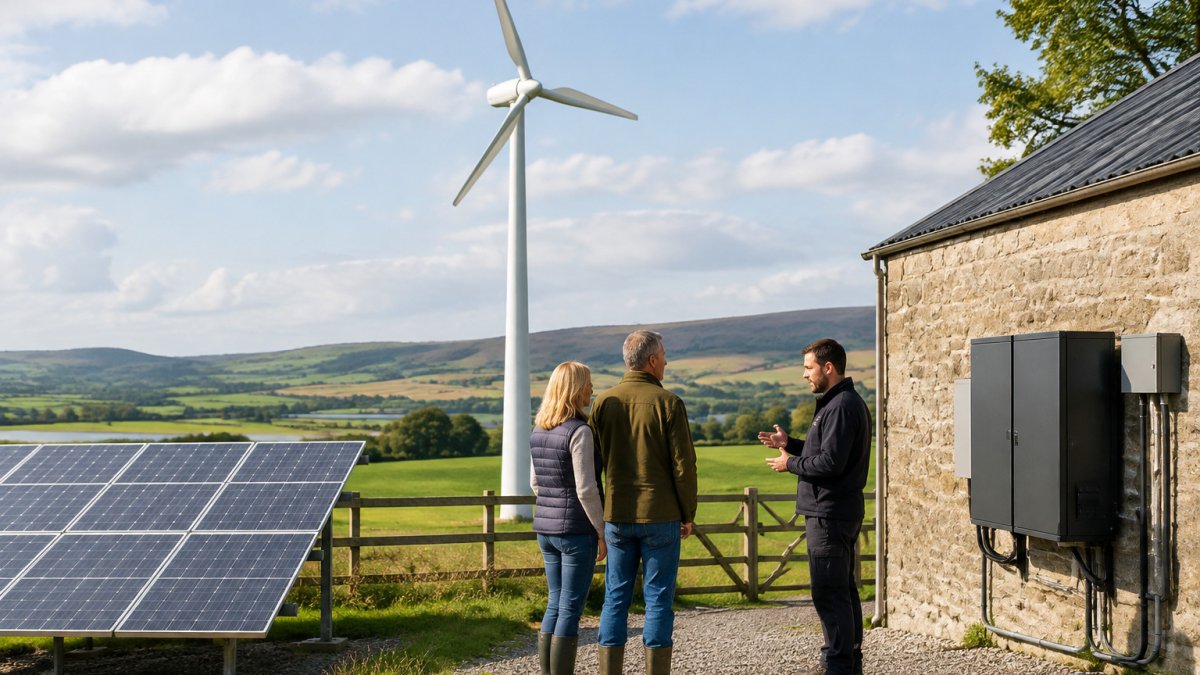
- Why a Wind Turbine for Farms UK Works Alongside Solar
- Installation, Maintenance and Fault Diagnosis
- Booking a Feasibility Study for Your Off-Grid Wind System
- Frequently Asked Questions
How Off Grid Wind Turbine Systems Work
Off grid wind turbine systems in the UK capture kinetic energy from moving air and convert it into usable electricity, storing surplus in a battery bank for when the wind drops.
This guide from Squirrel Energy explains the whole chain, from site assessment through to commissioning. Every system is engineered around the site.
The wind resource matters more than the turbine.
The Core Components of an Off-Grid System
Every off grid system comes down to five parts working together:
- Turbine and generator: the rotor, blades and alternator that convert wind into DC electricity.
- Charge controller: regulates voltage and current into the battery bank, preventing overcharge and deep discharge.
- Battery bank: stores energy for calm periods and overnight loads. Lithium iron phosphate is now the common choice for new installations.
Storage is what makes an off grid system liveable through a still week in January.
Small Wind Turbine vs Solar Panels: Which Suits Your Site?
Most UK sites suit solar better on pure output per pound, but wind earns its place wherever generation must continue through dark winter weeks.
Compare the trade-offs directly:
| Factor | Small Wind Turbine | Solar PV |
|---|---|---|
| Generation window | Day and night when windy | Daylight hours only |
| Peak season | Autumn to spring | April to September |
| Siting requirement | Exposed mast, clean wind, 10m+ clearance | Unshaded roof or ground array |
| Moving parts | Yes, bearings and blades | None |
| Maintenance need | Annual inspection advised | Occasional cleaning |
| Best for | Exposed upland sites, farms, remote off-grid buildings | Roofs, south-facing fields, constrained sites |
If your land has a stream or river with fall, hydro often beats both for constant output. You can read more about crossflow hydro turbines for farms and rural estates if running water is part of your site.
Exposed ground above a valley town and on surrounding moors generally carries a better wind resource than sheltered plots near a canal. That single fact decides more installations than any brochure figure.
Turbine Types and Output: What Your Site Can Realistically Generate
Output depends on rotor diameter, wind speed and the cube of that wind speed. Double the wind speed and you get roughly eight times the available power, which is why siting dominates every other decision.
Horizontal Axis vs Vertical Axis Turbines
Horizontal axis turbines, the familiar three-bladed design, are the default for off grid work: more efficient, better understood by installers and easier to maintain.
| Type | Efficiency | Turbulence tolerance | Maintenance | Best for |
|---|---|---|---|---|
| Horizontal axis | Higher | Lower, needs clean flow | Bearings, blades, annual check | Open, exposed sites |
| Vertical axis | Lower | Higher | Fewer accessible parts | Urban or gusty locations |
Watch out: a quoted rated power figure tells you almost nothing on its own. Ask for the power curve and the wind speed at which that rating is reached, then compare it against your site's measured wind speed at hub height.
Designing an Off-Grid Wind Turbine and Battery System
Design starts with the load, not the turbine. We total daily consumption in kilowatt-hours, add a margin for losses, size storage for the longest calm spell the site realistically faces, then size generation to refill that storage.
A practical design sequence looks like this:
- Build the load schedule. List every load, its running watts, hours per day and duty cycle. A farm workshop with a welder, a walk-in chiller and lighting has a very different profile from a remote bothy with a pump and a few lights. Note which loads are essential, which can be deferred to windy periods, and which are seasonal.
- Convert to daily energy and add losses. Sum the kilowatt-hours per day, then add an allowance for inverter, cabling and battery round-trip losses, around a fifth is realistic, though awkward sites with long cable runs need more.
- Set the autonomy target. Decide how many days the battery must carry the site through a calm spell. A remote off-grid dwelling might need three days; a farm with a backup generator might accept one. Autonomy drives battery capacity more than any other single decision.
- Size the battery bank. Work from usable capacity, not nameplate. Lithium iron phosphate typically allows deeper discharge than lead-acid, so a smaller nominal bank can deliver the same usable energy. Check that the battery management system can accept the charge current the turbine and controller can deliver, and that the inverter can draw the peak load without tripping the BMS.
- Match the turbine to the site, not the brochure. Use the power curve and the site's measured or modelled wind speed at hub height to estimate monthly generation, then compare against the load schedule month by month, not annually, because a system that balances on paper over a year can still leave the site short in January.
- Size the charge controller and inverter. The controller must handle the turbine's maximum output plus a safety margin, and the inverter must cover the peak simultaneous load, including motor start-up surges from pumps and compressors. A modest continuous rating with a generous surge rating is often the right compromise.
- Plan the dump load and overspeed protection. Once the batteries are full, surplus energy has to go somewhere. A diversion controller feeding a dump load protects both the battery and the turbine, and it must be sized for the turbine's maximum output, not its average.
For a full walkthrough of the process, including site assessment, planning rules and how the numbers stack up, see our guide on how to design a bespoke wind turbine system for your site.
The engineering input is where bespoke systems earn their keep.
Wind Turbine Planning Permission UK: What You Need to Know
Most small wind turbines need planning permission, and permitted development rights for wind are limited compared with solar. Because planning permission is only one part of choosing a suitable renewable system, it is also worth considering how home solar batteries could complement wind generation when storing energy for later use.
Expect the application to turn on three things: visual impact on the landscape, noise at neighbouring properties, and ecology, particularly bats and birds. A noise assessment and a bat survey are commonly requested. Height, rotor diameter and distance from dwellings all feed into the judgement.
Commission a site assessment before you submit anything. A planning consultant working from a proper wind and constraints survey produces a far stronger application than one working from a postcode.
Why a Wind Turbine for Farms UK Works Alongside Solar
Farms carry exactly the load profile that wind and solar together handle best: steady baseload from livestock housing, grain drying and cold storage, with seasonal peaks that rarely align neatly with sunshine.
The economics are strongest where the alternative is a constrained grid connection. Our renewable energy for farms and rural businesses page sets out the full picture.
Installation, Maintenance and Fault Diagnosis
Professional installation is not a formality. MCS certified installers follow recognised standards when they install and commission a system (About MCS Standards).
Safety starts with overspeed protection.
Maintenance is modest but not optional:
- Annual inspection of blades, bearings and fixings
- Torque checks on the mast and guy anchors
- Battery management system review and firmware updates
- Inverter and charge controller fault log review
Fault diagnosis on an ageing machine often comes down to the controller rather than the turbine itself. If you already own a turbine that is underperforming, repowering an existing wind turbine by replacing inverters and controllers is frequently the cheapest route to another couple of decades of service.
Watch out: a turbine that has been left to stand idle for a season can seize at the bearings or develop a flat spot on the brake, so a system that is not generating should still be inspected rather than ignored.
Booking a Feasibility Study for Your Off-Grid Wind System
A feasibility study is the point where a good idea becomes an engineered system.
Free energy audits and feasibility studies are available from Squirrel Energy. To understand what the visit involves and how to prepare, read how a renewable energy site survey works.
The difference between a wind system that pays for itself and one that sits idle comes down to design discipline: measured wind, honest load figures, matched storage and proper commissioning.
Frequently Asked Questions
Can you use a wind turbine to power an off-grid property in the UK?
Yes, provided your site has enough wind and the system is sized around your actual load. A typical off grid wind turbine charges a battery bank through a charge controller, and an inverter converts the stored DC power to mains voltage. The deciding factor is average wind speed at hub height, not peak gusts. A site assessment and feasibility study should come before any equipment is chosen, because a turbine on a sheltered urban plot will underperform one on exposed farmland.
Can a wind turbine charge batteries for an off-grid system?
It can, and battery charging is the core of most off-grid designs. The turbine feeds a charge controller that regulates voltage into a battery bank, and the bank supplies power when wind drops. Sizing matters: too small a bank and surplus generation is wasted, too large and it never reaches a healthy charge. A specialist designer will match turbine output, battery capacity and your daily consumption together rather than treating them as separate purchases.
Is a small wind turbine better than solar panels for an off-grid property?
Neither wins outright, because they generate at different times. Solar PV produces most in summer daylight, while wind often peaks in winter and through the night. In the North West, a hybrid of both plus battery storage gives far more consistent output than either alone. The right balance depends on your wind resource, roof or land space, and load profile, which is why a site-specific assessment beats a generic rule of thumb.
Do I need planning permission for a small wind turbine in the UK?
It depends on the turbine's size, its position and your property type. Some small domestic installations fall under permitted development, but height limits, separation from boundaries and noise considerations all apply, and conservation areas and listed buildings change the picture entirely. Commercial and agricultural turbines normally need a formal application. Check with your local planning authority before ordering equipment, and get written confirmation rather than relying on a supplier's verbal assurance.
Can wind turbines and solar panels work together off grid?
Yes, and combining them is often the strongest design. A hybrid system shares battery storage and a single inverter, so generation from either source tops up the same bank. Wind covers dull, blustery winter weeks when solar output falls, and solar carries lighter summer winds. The controller and inverter must be compatible with both sources, which is where custom system design earns its keep over off-the-shelf kits.
What should I consider before installing an off-grid wind turbine system?
Start with wind resource at the proposed hub height, then your daily and peak electricity demand, then the space and access for a tower and battery store. Planning constraints, noise at nearby properties, and maintenance access all shape what is feasible. Finally, decide who commissions and services the system. A specialist installer will survey the site, model output and design the system around your load rather than selling a standard package.
