
Last Updated: November 19, 2026
Quick Summary
A typical solar project timeline for businesses runs from first feasibility conversation to final handover, and the weeks on site are usually the shortest part of it. The process follows a predictable sequence: feasibility and survey, system design, planning and regulatory approval, grid connection application, procurement, on-site works, commissioning and handover.
- On-site installation for a straightforward rooftop array often takes two to four weeks.
- Submit the grid connection application early, even with a provisional capacity figure, to protect your schedule.
- Physical completion is not the same as permission to export; plan handover as a separate milestone.
- Delays cluster around incomplete survey data, planning queries, DNO queues and equipment lead times.
- Collate at least twelve months of half-hourly consumption data before the survey begins.
Table of Contents
- Why the Full Timeline Matters More Than Install Day
- The Commercial Solar Installation Process, Stage by Stage
- Planning Permission and Local Authority Requirements in Burnley
- The Commercial Solar Grid Connection Application
- How Long Commercial Solar Panel Installation Time Really Takes
- What Delays a Solar Project Timeline and How to Reduce Risk
- Your Commercial Solar Project Checklist
- Book a Free Energy Audit and Feasibility Study
- Frequently Asked Questions
Why the Full Timeline Matters More Than Install Day
Ask most businesses how long a solar project takes and you will get an answer about scaffolding and roof work. That answer is incomplete. A typical solar project timeline for businesses runs from first feasibility conversation to final handover, and the weeks on site are usually the shortest part of it.
That gap matters commercially. Budget cycles, board approvals and operational planning all hinge on knowing when the system will actually be generating. If you plan around install day alone, you will be surprised by grid connection queues, planning consultations and equipment lead times.
Below, we break the commercial solar installation process into its real stages, with realistic ranges and the dependencies that trip projects up. This guide is written for operations managers, farm owners and facility teams across Lancashire and the wider North West who need to plan properly rather than hope.
The Commercial Solar Installation Process, Stage by Stage
The commercial solar installation process follows a predictable sequence: feasibility and survey, system design, planning and regulatory approval, grid connection application, procurement, on-site works, commissioning and handover. Each stage depends on the one before it, which is why compressing one rarely compresses the whole.
Feasibility, Site Survey and Structural Assessment
Feasibility comes first and sets the ceiling on everything else. A site survey establishes roof orientation, shading, available area and structural capacity, while an assessment of your electricity consumption data determines the realistic system size in kilowatt peak. For a reader who wants the detail, our guide explains how a renewable energy site survey works.
Two things derail this stage. The first is incomplete consumption data: half-hourly readings tell a far clearer story than a single annual bill. The second is roof condition. A roof nearing the end of its life should be remediated before panels go on it, not after, and that decision can add weeks.
System Design and Engineering
Design translates the survey into a specification. Engineers size the solar array against your load profile, select the inverter and mounting system, and decide whether battery storage or generator integration belongs in the scheme. System complexity is the main variable here: a straightforward rooftop array moves quickly, while a micro-grid with storage and backup power takes longer to model properly.
This is where cheap quotes and good ones diverge. A design built on assumed consumption rather than measured data will underperform, and no amount of fast installation fixes that.
Planning Permission and Local Authority Requirements in Burnley
Most commercial rooftop solar falls under permitted development, but not all of it. Larger arrays, listed buildings, conservation areas and ground-mounted schemes can require a formal application to the local planning authority. In Burnley, that means submitting to the council and allowing for the statutory consultation period, which is measured in weeks rather than days.
Flood risk, green belt designation and the building's setting all influence the outcome. Businesses searching for commercial solar installation near me in Burnley can review the local solar panel installation service and book a free energy audit to clarify what their site needs.
The Commercial Solar Grid Connection Application
The commercial solar grid connection application is a stage that can extend a project beyond expectation. Any system that exports electricity needs approval from the distribution network operator (DNO), and the DNO's process is not a single form. It runs through distinct stages, each with its own dependencies.
First comes the application itself, which requires the proposed export capacity in kilowatts, the connection point, and technical details of the inverter and protection arrangements. The DNO then carries out a technical review against the existing network. Where there is sufficient headroom, a connection offer follows relatively quickly.
Regional constraints vary considerably. Network headroom varies by location, and constrained areas can affect connection timing. A connection offer may therefore include reinforcement work, upgrading a substation or cabling, which is scheduled by the DNO and can add weeks or months to the programme.
Export capacity, metering arrangements and Smart Export Guarantee registration all sit within this stage, but they are not the same thing. Physical connection and permission to export are separate milestones. A system can be fully installed and generating for self-consumption while the export approval is still pending, which is why the programme should distinguish between the two.
Watch out: submitting the connection application after the design is finalised can leave you at the back of a queue that formed months earlier. Submitting early, even with a provisional capacity figure, is the single most effective way to protect your schedule.
How Long Commercial Solar Panel Installation Time Really Takes
Commercial solar panel installation time on site typically runs from a few weeks for a straightforward rooftop system to considerably longer for complex or phased projects. The physical works include mounting system installation, panel lifting, DC and AC cabling, inverter commissioning and testing. But the duration on site is only part of the story, and for a business, the disruption is what matters.
A straightforward rooftop array on a warehouse or office can often be completed in two to four weeks of on-site work, depending on roof access, weather and the number of roof penetrations. A phased project across multiple buildings, or one with battery storage and generator integration, will take longer because the commissioning and testing sequence is more involved. Ground-mounted schemes add civil works and trenching, which extend the programme.
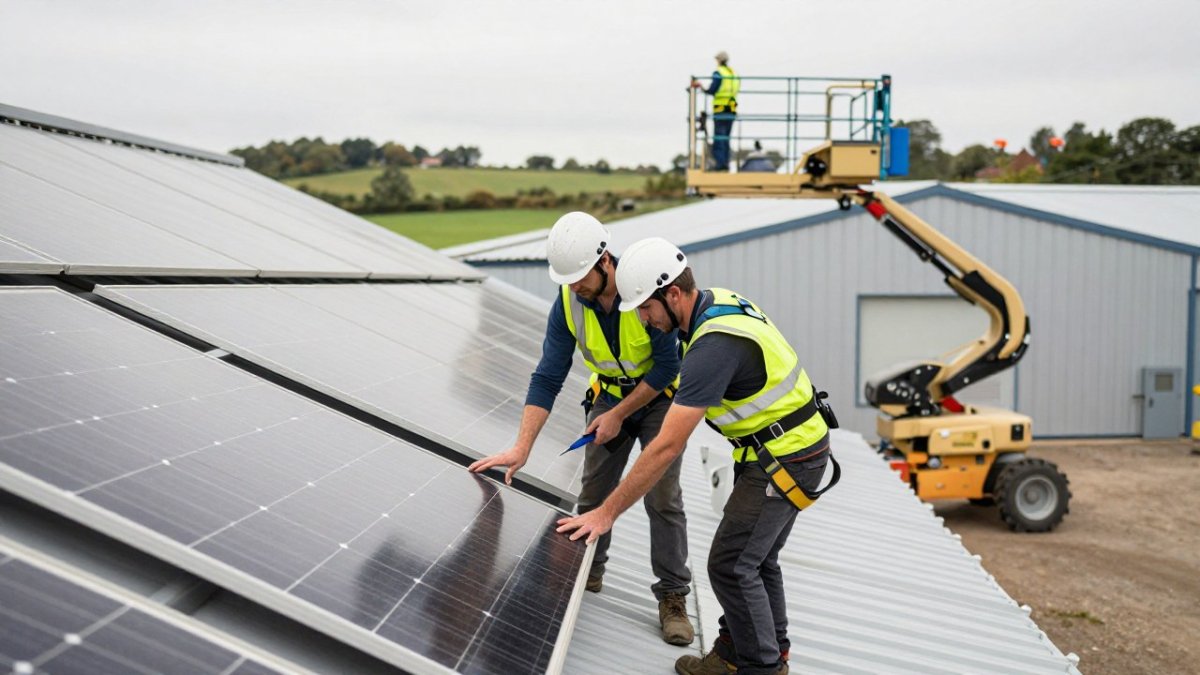
Business continuity is where a specialist installer earns their keep. Access arrangements, working hours and shutdown windows all need to be agreed before scaffolding goes up. A factory may need to isolate a distribution board for a short period, and that is best planned around shift patterns rather than discovered on the day.
For farmers, the calculation is different. Grain stores, livestock buildings and seasonal workloads mean the installation window may be narrow. The works can be sequenced around harvest or lambing, and the array can be split across buildings to reduce the time any one building is out of action.
Watch out: physical completion is not the same as permission to export. The system may be installed and generating for self-consumption while the DNO approval and metering arrangements are still being finalised. For industrial sites with complex roofs or generator integration, our industrial solar panel installation guide covers the additional considerations.
What Delays a Solar Project Timeline and How to Reduce Risk
Delays cluster in four places: incomplete survey information, planning queries, DNO queues and equipment lead times. Inverter and mounting system availability can move, particularly for larger commercial specifications, so procurement should start as soon as design is fixed.
| Delay Risk | Typical Cause | How to Reduce It |
|---|---|---|
| Survey delays | Missing consumption data, roof access | Gather half-hourly data early |
| Roof remediation | Structural or covering issues found late | Survey roof condition first |
| Planning queries | Conservation area, listed status | Check planning position upfront |
| DNO queue | Export capacity constraints | Submit connection application early |
| Equipment lead times | Inverter and mounting availability | Fix design and order promptly |
Watch out: ordering equipment before the DNO offer is confirmed can leave you holding kit that does not match the approved export capacity.
Your Commercial Solar Project Checklist
- Collate at least twelve months of half-hourly consumption data
- Commission a structural and roof condition assessment
- Confirm planning status with the local authority
- Submit the grid connection application as early as possible
- Fix the system design before procurement begins
- Agree a phased works programme around business operations
- Plan commissioning, testing and handover dates
- Register for the Smart Export Guarantee after commissioning
Before committing, it is worth reading expert advice on choosing solar and battery storage, including system sizing, returns and the questions to put to any installer.
Book a Free Energy Audit and Feasibility Study
Every project timeline starts with knowing what your site can actually support. A free energy audit and feasibility study from Squirrel Energy gives you measured consumption data, a structural view of your roof and a realistic programme from survey to handover.
We design bespoke systems for each site. Our electrical engineers bring over 40 years of experience, and our installers are MCS certified and approved by Sunsynk and SolaX. We are Smart Export Guarantee registered, and Squirrel Energy has been featured on BBC Breakfast.
Get started with Squirrel Energy and turn an uncertain timeline into a planned programme with a system built around your operation.
Frequently Asked Questions
How long does a commercial solar project take in the UK?
Most commercial projects run from several months to a year from first survey to handover. A straightforward rooftop system on a sound roof might move from feasibility to commissioning in a few months, while larger arrays, battery storage or micro-grid integration take longer. The solar project timeline is driven less by the physical install, which is often a matter of weeks, and more by design, planning and the grid connection application. A free feasibility study will give you a realistic range for your site.
What are the stages of a commercial solar installation process?
The commercial solar installation process typically follows these stages: feasibility and energy audit, site survey and roof structural assessment, system design and engineering, planning permission where required, grid connection application to your distribution network operator, equipment procurement, on-site installation, commissioning and testing, then handover and Smart Export Guarantee registration. Each stage has dependencies, so a delay in the grid connection application can push back the whole schedule even when the roof work is ready to go.
Does a business need planning permission for solar panels?
Many commercial rooftop installations fall under permitted development, but not all. Listed buildings, conservation areas, flat roofs with taller mounting frames and ground-mounted arrays often need a formal application to the local planning authority. Local authorities assess each case on its merits, so it is worth confirming early rather than assuming. Building regulations approval and, for some sites, a structural assessment also apply. A specialist installer will check the position for your specific building before design is finalised.
How long does a commercial solar grid connection application take?
The commercial solar grid connection application is often the longest single stage and varies by distribution network operator and local network capacity. Some applications are processed in a matter of weeks, while constrained areas or larger export capacities can take considerably longer. Because the connection offer sets your export capacity, it directly shapes system design. Submitting the application early, alongside feasibility, is one of the most effective ways to keep the overall solar project timeline on track.
Can a business keep operating during solar panel installation?
In most cases yes. Rooftop installation work happens above the working floor, and the switchover to solar is planned around your operations to minimise disruption. The main interruption is a short shutdown during commissioning and connection, which is scheduled in advance. For farms and manufacturing sites, work can be planned around peak periods such as harvest or production runs. Discuss your operating calendar at the survey stage so the commercial solar panel installation time is built around your business, not against it.
What can delay a commercial solar project?
Common delays include roof condition issues found at structural survey, grid connection queues and capacity constraints, planning permission where required, and equipment lead times for inverters or battery storage. Weather affects on-site works, particularly in autumn and winter. Poor site access or complex roof structures add time to installation. A detailed commercial solar project checklist, agreed before work starts, helps you spot these risks early and sequence the stages so one delay does not stall everything else.
